
Quantum Biology
Myth or Reality?

Physicists and biologists did not believe (and most still don’t) that quantum effects could have anything to do with biological processes and, as we shall see in the next post, with consciousness. After all, the quantum effects we observe are so tiny that it is hard to imagine how they could influence structures like a living cell, which is a macroscopic object compared to atoms and elementary particles. Any quantum phenomenon seems to be very unlikely to have any measurable effect and influence, just as one does not expect that a little feather hitting a truck will make the latter change its course. Moreover, if some quantum effect would arise (say, for instance, quantum superposition or entanglement phenomena among molecules in cells), the environment and the thermal heat bath to which every living creature is subjected would quickly cancel it by quantum decoherence. That is, the external “noise” would immediately erase any quantum effect, rendering it useless.
However, Nature has surprised us so many times in the past and may do so this time, too. Quantum biology (QB) is a research field in its infancy but there are several indications that this may change in the not-too-distant future, though the speculations that QM may have something to say in biology are not new. Already in 1944, Schrödinger wrote a famous booklet entitled “What is Life?” in which similar conjectures were advanced for the first time. He asked if the ingredients that seem to make life so special and biology so different from chemistry might be traced to QP.
Also, the German physicist Pascual Jordan, who, among many others, contributed to the development of QM, speculated about the possible connections between quantum indeterminism and life. If the indeterminism of QP acting in cells could be amplified by some unknown mechanism at macroscopic scales, that could potentially explain the unpredictability of the complex biological structures that we are. Despite his achievements in theoretical physics, after WWII, Jordan’s reputation became discredited because of his connections to Hitler’s national socialistic ideology, as he had joined the Nazi party and its paramilitary unit. Probably because of this past political association, his works have been long dismissed and his conjectures about the possible connections between QP and biology have been forgotten.
In 1963, the Swedish physicist Per-Olov Löwdin suggested that the tunneling of protons between atomic nuclei might be a mechanism that could induce DNA mutations, and introduced the term ‘quantum biology’. This hypothesis must still be proven but it sounds plausible to conjecture that quantum tunneling is at work between nucleotides, i.e., the building blocks that make up DNA and that carry genetic information. The two DNA strands are held together by hydrogen bonds. In the process of replication, in which each strand makes a copy of itself, there is a small probability that a proton might ‘jump’ via a quantum tunneling process from one hydrogen atom to the other, thereby inducing a mutation. Computer simulations indicate that proton quantum tunneling in DNA is large enough to cause point mutations in the genome faster than the biological timescales.
In the 1980s-90s, British physicist Roger Penrose and the anaesthesiologist Stuart Hameroff advanced the hypothesis that QM could be at the base of the emergence of consciousness in the activity of neurons in our brains. Tiny microstructures in the cytoplasm of cells, called ‘microtubules’, are small enough to potentially support some quantum phenomenon. No evidence backs such a claim so far. We will return to this in the next article.
Not until 2014 did the British theoretical physicist Jim Al-Khalili publish a popular science book on QB with the suggestive title “Life on the Edge: The Coming of Age of Quantum Biology”, which made the subject known to the broad public.
All these attempts to look for a possible interface between the quantum world and biology rest on the fact that nowadays we know how molecular biology, genetics, and organic chemistry have been very successful in describing the processes of the functions of life in the microphysical domain. These are all about molecules essential to living organisms, many of which are made up of only a few atoms and stick together through chemical bonds which, ultimately, could be described only by resorting to the atomic quantum orbital models that are based on the laws of QM.
In fact, in the last decade, several instances of (though not completely conclusive) experimental evidence have emerged to indicate that QM might, indeed, play a role in biochemistry. For example, there is nowadays some consensus that enzymatic activity can’t be explained without resorting to QP. Enzymes are proteins that act as catalysts in chemical reactions, accelerating biological processes in cells. Without enzymes, almost no living being could survive; they are among the most fundamental ingredients for life, at least as we know it. Some enzymes’ chemical kinetics are faster than what classical chemistry can explain. Studies show how electron transfer (redox reaction) over long distances from one molecule to another (redox centers) could be achieved via quantum tunneling effects. This quantum mechanism plays an important role in enzymatic activity.
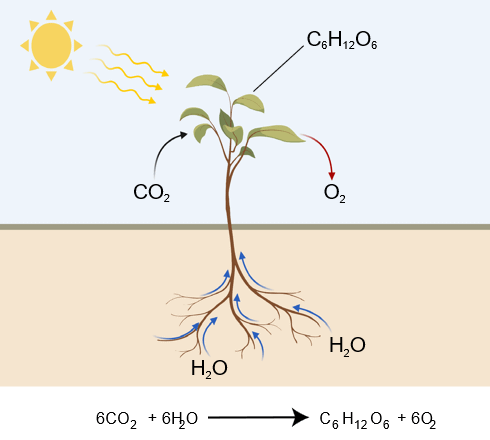
One of the strongest indications that quantum effects are at work in cells is photosynthesis. As everyone learns in school, photosynthesis is the chemical reaction in plants that converts the Sun’s light into chemical energy. When photons hit the green-pigmented chlorophyll molecules, these induce, through an electron excitation mechanism, a charge separation triggering a complex chain of chemical reactions that convert them into chemical energy and transform carbon dioxide and water into glucose and oxygen. This energy transfer from the chlorophyll molecules to the cell’s internal reaction sites has an efficiency of almost 100%, which can hardly be explained by classical chemical or physical principles. It looks like photosynthesis resorts to QM in order to achieve such efficiency. In fact, some studies suggest that long-lived quantum coherence combined with quantum tunneling may furnish the needed mechanism. Only by this mechanism can the packets of energy be transported to the cell by simultaneously following all possible paths to the reaction center.
Currently, research is seeking to determine whether QM could explain olfaction – that is, the biochemical reactions we use for the sense of smell. We know that olfactory receptors in the nose are quite efficient at binding odorant molecules. However, it is not entirely clear how the receptor molecules bind and recognize the different chemical substances. One theory states that the shape and size of the molecules are what determine the types of smells. These molecules are detected by the olfactory receptors onto which they must fit according to their shape and, by special signaling to the brain, decode it as different smells. In other words, according to this hypothesis, the recognition of smells is related to the form of the molecules carrying that smell. However, more recent tests suggest that molecules with very different shapes can lead to the same smell. Therefore, a new theory suggests that olfactory experience is not mediated by the shape of molecules but, rather, by their frequency of mechanical vibration, which is triggered by the quantum tunneling of an electron between the olfactory molecule and specific amino acids within the olfactory receptor. The latter theory is still somewhat controversial but experiments suggest that both are not mutually exclusive: The chemical composition, shape, and size of the molecules determine whether they are ‘locked’ into the receptors; their vibrational frequency then determines what we perceive as smell.
Another domain in which, quite surprisingly, QB might play an important role, and which has recently attracted attention, is migratory birds. It has been shown that at least some species are sensitive to the Earth’s magnetic field – an ability called ‘magnetoreception’. The most striking example is the European Robin, which migrates in the winter from northern Europe to the Mediterranean Sea, and then back in the summer.

For a long time, scientists wondered what the reference system of these birds could be such that they always find their way along their thousand-mile journey. The Earth’s magnetic field seems to be the answer. However, it is a mystery as to how they can perceive such a weak magnetic field. Research on the European Robin suggests that the directional information about the Earth’s magnetic field lines (more precisely, its inclination with respect to the surface) might be conveyed to the bird’s brain by a mechanism relying on QM – in particular, on quantum entanglement. It is triggered by the light shining on the bird’s retina, where magnetically sensitive protein radical-pairs molecules, called ‘cryptochromes’, reside.
A radical-pair is made of two molecules with an odd number of unpaired electrons due to an ionization process photo-induced by light radiation. These two electrons are separated because each resides on its respective molecule but they are an entangled singlet. Of course, each of these electrons has a spin, which gives magnetic momentum to each separate molecule. And, just as the electron’s dynamic can be influenced by its own magnetic moment, here, also, the Earth’s magnetic field can change the spin state. Therefore, the radical-pair mechanism explains magnetoreception insofar as a magnetic field can affect the radical-pair’s chemical reactivity, which, in turn, determines the speed at which other chemical reactions and products are formed. In short: The direction of the Earth’s magnetic field can, through electron entanglement, catalyze the biochemical reactions in the robin’s eye. These reactions are then signaled to its brain. We will never know unless we become a European Robin but perhaps, thanks to QM, migrating birds might literally ‘see’ magnetic fields and orient themselves along these field lines.
QB is far from being an established and accepted science. So far, the evidence supporting it has gone beyond mere speculation but it isn’t conclusive. Many physicists and biologists remain skeptical. As with quantum computing (QC), QB isn’t really a new field of research. However, the decisive difference between the two research lines is that, while QC has been intensively pursued and heavily funded by billions in investment in the last couple of decades due to its potential practical and commercial applications, QB remains a largely ignored science. It has never received serious attention apart from that of a few scientists and a handful of research institutions. Thus, it has remained very limited in terms of scope, funds, and time. One of the reasons for this is that nobody has been able to come up with a convincing mechanism that could prevent quantum decoherence due to thermal noise and environmental interference.
On the other hand, even if one day we discover quantum phenomena influencing or regulating life functions, it would not be clear what this knowledge could be good for. We live in a society driven by pragmatism and utilitarianism. If a relatively small field of research, however interesting and original it might be, isn’t seen as useful for some practical and commercial application, it rarely gets funded. Pure science for the sake of knowledge is out of fashion.
One can only hope that QB will receive more attention in the coming years. It would be interesting to know for sure whether QM does, or does not, play a role in the development of life. If it does, this could open an entirely new line of research leading to a paradigm shift in biology and potentially also to applications. The history of science shows that pure science can – and, indeed, in most cases does – lead to unexpected applications. Galileo, Newton, Einstein, and Planck, like many other great physicists, were driven primarily by a thirst for knowledge and not by the prospect of applying their discoveries. And yet, without their discoveries, we would still be stuck in the technological middle ages. Despite its inception half a century ago, QB remains a non-mainstream science. One can only hope that this will change soon.
If you find value in my work, please consider supporting me by buying me one or more coffees. Every contribution means a great deal to me—I mean it!—and helps me devote more time to research, write new articles, and continue creating content for this community.
Alternatively, you can…
Thank you for your support and for being part of this journey.
Great overview of a vastly underappreciated field, Marco.
Your breakdown of proton tunneling in DNA replication provides a brilliant, systematic rationale for what we might call 'replicative fading'—the inevitable, generational drift that happens when you copy a copy of a copy (like a game of telephone).
Traditionally, we blame genetic drift and aging on 'wear and tear' or faulty cellular machinery. But quantum biology suggests this drift is a physical truism. Even in a perfectly shielded environment with flawless replication enzymes, quantum uncertainty ensures the subatomic 'letters' themselves will shapeshift. It seems chaos and aging are literally baked into the quantum glue of our biology.
I work with fascia, and am convinced some quantum stuff is happening in the body. Knees rotates, feet and arms starts to move on their own, pain disappears by just touching the right places. Fascia connects everything, touch somewhere and it’s noticed somewhere else.
It is piezoelectric and penetrates everything, even the cells. Touching between the ribs can make people breathe again. And a lot more.