
Quantum Indistinguishability
When distinction no longer makes sense

The following essay is adapted from a chapter of my book on quantum physics.
A less frequently discussed but deeply intriguing aspect of quantum phenomena is how the concepts of distinguishability and indistinguishability take on meanings that depart radically from everyday common sense. The concept of “quantum indistinguishability,” which emerges from quantum scattering processes, is also a good conceptual introduction to the famous phenomenon of quantum entanglement
Quantum indistinguishability might at first look like the classical indistinguishability of two objects having the same physical properties between which one cannot distinguish. This might not sound particularly exciting. Sometimes it is, indeed, presented by physicists in this way—physicists who do not bother about the subtler conceptual foundations to a popular audience or to their students. However, a profound and important difference exists between classical and quantum indistinguishability.
For our everyday experience, every physical object is distinguishable, even inside a collection made of many objects having exactly the same properties.
Consider marbles of the same size, shape, and color contained in a jar. They are still distinguishable by virtue of their unique positions in space. However, if one shakes the jar and loses track of their positions, we no longer know which marble is where, and in this sense they can be said to be “indistinguishable” from one another.
However, this is a lack of knowledge form our side, not an inherent indistinguishability of the marbles themselves. We might call it an “epistemic indistinguishability”. In fact, when, in our human macroscopic classical world, we want to maintain two equal objects as distinguishable even when subjected to a complicated reshuffling process that is difficult to keep track of, we can do this simply by labeling them, say, with label A and label B. Then start the process—for example, shake them inside a box and later look at where one or the other object is simply by reading the labels.
However, one might argue that appending labels is already differentiating between two unequal objects!
Ok, then let’s take a different approach: we could follow each object’s path during the mixing process separately, looking at where one or the other object moves in space and time, even without labels. If this will be too fast and complicated, we can eventually record it using a video camera. For example, consider two billiard balls having exactly the same properties (mass, size, color, etc.) and colliding.
This is our everyday experience with the classical mechanical scattering process, which involves hard and well-defined objects, just chunks of matter. (This collision process could be elastic or inelastic, but that fact is not so relevant to our considerations here.) If they interact, we can nevertheless distinguish one from the other, for example, by letting them collide head-on, as in the figure below, and then observing that the first is scattered in one direction while the second is scattered in the other direction.
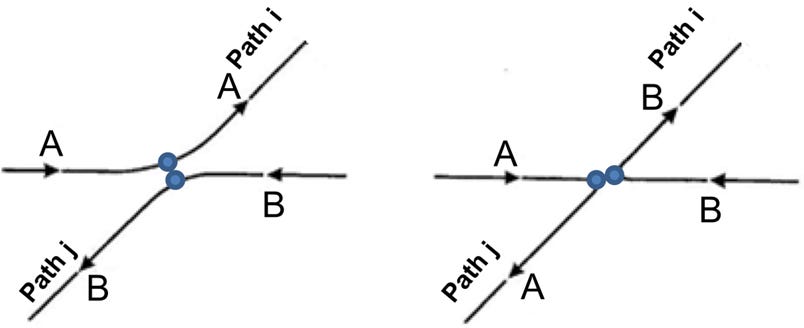
We can track their trajectory simply by looking down at the billiard table from above. In the classical view, we determine, during the process, whether billiard A went along path i and billiard B went along path j (Fig. 1 left), or whether, to the contrary, B went along path i, while A went along path j (Fig. 1 right). It is as simple as that.
So, in this Newtonian mechanical perspective, nothing is fundamentally indistinguishable, and if it is, that is only because we have not looked at the process carefully enough; in principle, distinguishability is always possible. Classical indistinguishability is epistemic—that is, it is only a notion which reflects our ignorance; it is not an ontological statement.
If, however, we would like to know what happens during a scattering process between two elementary particles, say, two electrons, we must consider the collision as not like that of two billiard balls coming in direct contact with each other (that is, ‘touching’ and repelling each other); rather, we must take into account the fact that an electric field surrounds them.
In this case, because the electrons have the same negative electric charge with the same polarity, they repel each other. For tiny charged particles, the scattering never involves direct contact between particles; the repulsion occurs because of the mutual interaction of the extended electric field of both particles. Therefore, one must refine the previous mechanical scattering model with that of the following figure.
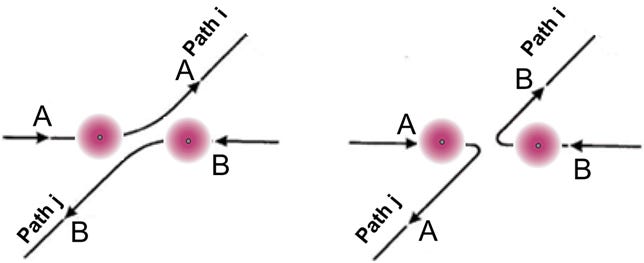
The trajectories are deviation paths caused by the mutual interaction of the two electric fields, without the particles having any direct contact, at least not in the classical mechanical sense of which we are accustomed to thinking.
Keep in mind that also, at the macroscopic scale, there is no such thing as “direct contact,” as naively suggested by Fig. 1. Every interaction, “contact” and scattering between material bodies—including that of billiard balls—is microscopically an electric repulsion between the electron clouds of the atoms and the molecules of which a body is made. In our everyday lives, we perceive the existence of hard objects like stones, but this “hardness” boils down to microscopic interactions between particles of the kind in Fig. 2.
Therefore, as to what regards distinguishability, things turn out to be a bit more complicated. You may have already seen another naive assumption we used for the case of the billiard balls. To observe the collision process, we must have some light in the room, which the billiard balls reflect, to obtain an image that tells us which went along which path. At human macroscopic scales, the reflection of photons on billiard balls is such a tiny perturbation of the system that we can consider it completely negligible. For two electrons, however, we can’t forget this little photonic perturbation. Here we are in the domain of Heisenberg’s uncertainty principle (see here). In the microscopic realm of elementary particles, the light photons would scatter the particles we would like to distinguish and would disturb their trajectories, rendering impossible the kind of classical distinction process mentioned above. The act of observing a quantum object inevitably introduces an interaction that perturbs the object.
However, the perturbation argument is not entirely correct, or at least it isn’t the whole story that Heisenberg’s uncertainty principle is telling us.1
Let us, therefore, consider a more quantum mechanical version of the whole problem. Imagine again that the two identical particles—say, two electrons, A and B—scatter with each other, as in Fig. 3. We do not shine any light particles on them to track their whereabouts, so there is no perturbation. Rather, we attempt to distinguish the two cases illustrated by Fig. 1 and Fig. 2, by detecting one of the particles at detector D. In quantum physics, particles are no longer depicted as point-like objects or “marbles,” but rather as “wave-packets” described by “wave functions”. Ultimately, two particles, A and B, interact with each other as wave-packets within a tiny region of space and emerge from this scattering process as wave-packets as well along paths i and j.
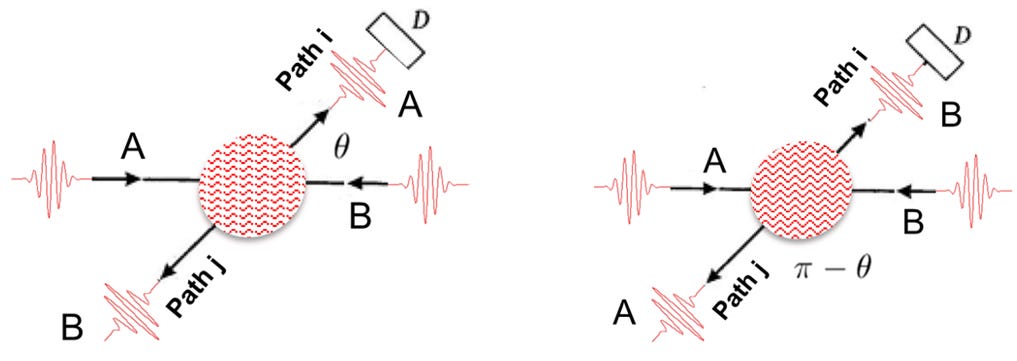
Now, with our Aristotelian intuition, we might think again of the two possible cases considered previously. The two particles scattering at angle theta or 180°-theta. We might then be tempted to bring detector D ever closer to the small interaction region called the ‘collision vertex’ and observe which particle took path i and which particle took path j.
Unfortunately, Heisenberg’s uncertainty principle prevents us from doing so!
We are not allowed to know what is going on inside this collision vertex, as this is a tiny interaction region where quantum uncertainty reigns. And because we don’t know what happens inside this interaction space, we can’t tell which of the two particles, A or B, hits detector D. However, it is not just like shaking a couple of marbles in a black box into which we can’t look. As we have clarified while discussing Heisenberg’s uncertainty, quantum tunneling and the superposition principles, here we are not allowed to think of the two particles in this region as having exact position and momentum at all, not even in principle.
Here, the wavy nature of the particles, which must be thought of as two wave-packets, are no longer negligible. The trajectories inside this region cannot be definite particle paths as our naive intuition would like to consider them. There is no such thing as a point-like particle following a precise trajectory i or trajectory j.
What instead becomes important at these scales are the diffraction and interference phenomena between wave packets. In QM, a scattering process is a diffraction of probability waves. Therefore, we must resort instead to a description with the wave function. In fact, physicists say that the wave functions overlap and interfere at the collision vertex. It is this that makes particles indistinguishable in QM, not the idea that the observation as such perturbs the system. They are not distinguishable, not even in principle. It is a form of indistinguishability that, again, we must carefully avoid confusing with any classical form of indistinguishability. Particles are not distinguishable because of our ignorance—say, because we couldn’t look at the collision vertex with sufficient accuracy. Here, they are indistinguishable because, despite our human reductionist mindset would like to believe otherwise, we must understand the two particles as two wave packets merging and becoming one, and only one whole system without distinctive sub-parts in the interaction region, and which is described by one single wave function.
Yet, Fig. 3 represents a still somewhat naive understanding of what is really going on. Although such depictions are common found in textbooks, they do not tell the whole story. In Fig. 1 to Fig. 3, we considered only a special case scattering angle. The particles are shown to be scattered along two opposite directions. However, also other directions are possible. If we consider all the possible angles occurring in a scattering process, we must build a wave function that also has an angular dependence on theta—that is, at the collision vertex, the two particles must diffract each other in all directions, like a plane wave diffracts at an object’s boundaries.
In fact, to simplify this scattering process, consider one of the two interacting particles as a point-like center of wave diffraction (the dot in Fig. 4 left) at rest fixed in the laboratory reference frame, and consider the other as an incoming wave packet. If we consider the wave packet of the incident particle to be large relative to this point-like diffraction center, it can be represented as an incident plane wave. Then, once the plane wave hits the localized target region, the resulting wave function involves a superposition of an incident plane wave and a scattered spherical wave (Fig. 4 right).
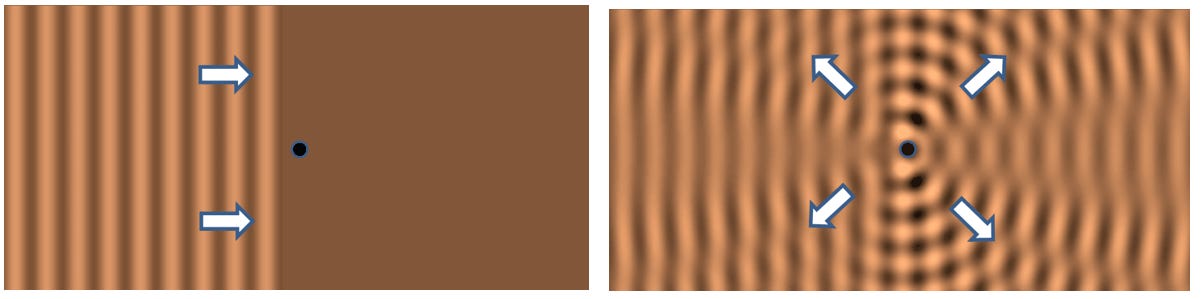
From the perspective of the other particle, the same can be said. It also will “see” an incoming front and diffract it into a superposition of an incoming plane wave and an outgoing spherical probability wave. The resultant wave is a more or less complicated outgoing spherical probability wave expanding from the interaction center towards the outside world (Fig. 4 right) until a similar scattering and interaction process occurs again with another particle.
This should give you at least a qualitative understanding of what QP interactions and scatterings of particles are about.2 The probability of finding the scattered particle is no longer given by well-defined and deterministic paths of tiny particles or fields (as in Fig. 1 to Fig. 3) but is determined by a spherical outwardly expanding probability wave.
The situation in its temporal evolution and with the detector induced quantum state reduction is shown in Fig. 5.3
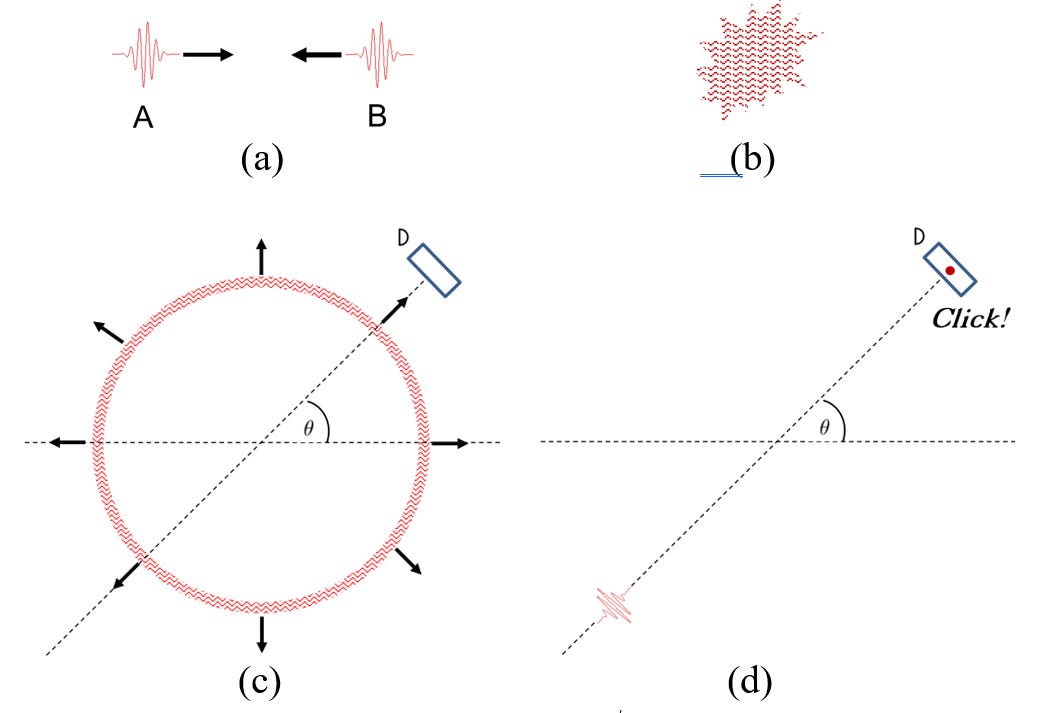
The different figures, a, b, c and d, represent different temporal snapshots of the scattering event. In Fig. 5 (a), we have the two incident wave packets of each particle A and B that, before any mutual interaction, are still distinguishable in space. What makes them distinguishable are simply their different spatial coordinates, not any inherent property, as they are two electrons with exactly the same properties.
Fig. 5 (b) represents the short time interval during which the two particles interact. Here, the two wave functions overlap and the individual spatial coordinates of the individual particles are no longer distinguishable, not even in principle due to Heisenberg’s uncertainty principle. The two probability waves diffract and interfere with each other in complicated processes. The scattering process is represented graphically simply by a little “bubble” in space which hides the details of the interaction.
After the collision, what emerges are still not two nicely separated wave packets (the naive quantum scattering of Fig. 3), but a spherically shaped shell wave function (Fig. 5 (c)) whose amplitude is modulated by a function that has an angular dependence in spherical coordinates as , also called the “scattering amplitude”. This spherical probability wave spreads into outer space according to the particles’ speed. As long as there is no detection or any other interaction with other particles, this spherical wave proceeds undisturbed and no logical inference is allowed about the particles as distinct entities. This is because, at this stage of the process, there is still nothing like two point-like particles, nor even such a thing as two wave packets—only a spherical probability wave expanding outwards in space.
Only when this spherical envelope reaches the detector and when the detector clicks (Fig. 5 (d)) will the wave function “collapse”, by a spatial localization, to a nicely defined spot inside the detector (say, on a pixel of a CCD-camera), which tells us that there, what we call a ‘particle’ must have interacted with it. At the same time, the other particle which emerged along the other path must be visualized again with a wave packet traveling in the opposite direction.
At this point, we no longer have any means of establishing which of the two particles made the detector click. This is for the simple reason that what emerges from the collision vertex is not a system that can be reduced to two separated particles in the first place, but is only one single and unique whole wave function spreading out and waiting to be detected. Only when the detector clicks will this “whole” suffer state reduction and reveal itself again as what we call “two particles”: the one showing up at the detector itself and the other possibly even light years away, on the opposite path, where we could eventually place another detector. Before the detector clicks, the two particles are an undifferentiated whole without parts or, in the common quantum parlance, they are said to be “entangled.” This is something which hints at an inseparable holistic interpretation of reality, as everything in physical reality can be considered a large number of particles continuously interacting with each other.
A real quantum indistinguishability goes even further. It must also take into account the superposition principle. That is, we must allow also for our intuitive understanding of the quite disturbing eventuality that each particle travels both paths at the same time! In quantum physics one must represented the system of two particles taking one AND the other path (the two paths corresponding to the left/right pictures of the previous figures).
For sake of simplicity I summarize the distinction between the classical concept of two electric particles scatterings and its quantum version with that of the electric scattering of Fig. 2.
Fig. 6 top: Either one particle is deviated along path A upwards and the other along path B downwards OR one particle is deviated along path A downwards and the other along path B upwards.
Fig. 6 bottom: Both particles are deviated along upwards AND downwards at the same time.
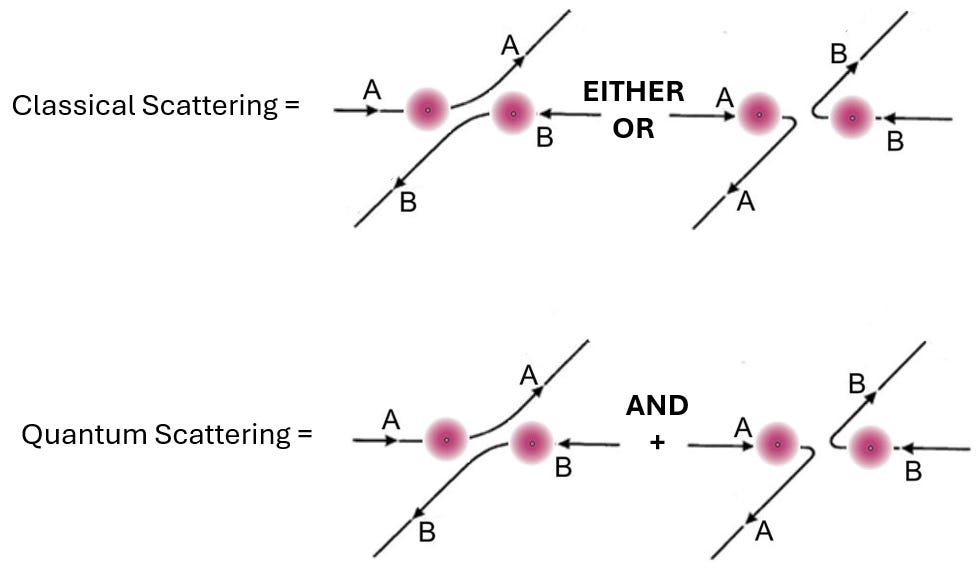
In the quantum scenario, any notion of distinguishability fades away. Not only is it impossible to distinguish the two electrons after the scattering process, but the question no longer makes sense. If both electrons travelled along both paths at the same time, the single electron measured at detector D is another “entity” that emerges from the collision vertex, which is the spherical wave function. What detector D measures is a particle, which, of course, preserves exactly the same properties of the incident ones but can no longer be considered either A or B (or, maybe A and B are the very same electron?). Quantum physics reminds us that any logical retro-ductive definiteness is a bad habit of the human mind. This is the real quantum indistinguishability. It is just another form of quantum superposition.
In conclusion, generally speaking, what we must bear in mind is that quantum indistinguishability does not emerge because of our ignorance or the imprecision of the measurement devices. It is not an epistemic but rather an ontological indistinguishability. The quantum indistinguishability principle states that identical particles (like electrons or photons) are fundamentally impossible to distinguish from one another, even not in principle (that’s, after all, why it is called a “principle”…)4
Nature insists on the indistinguishable quantum version at all costs. There is no perturbation effect or measurement imprecision preventing us from distinguishing between them. Rather, quantum indistinguishability emerges due to the superposition of possibilities. The simple fact is that there is nothing to distinguish, and there are no differentiated parts to differentiate in the first place.
This is the base, the conceptual foundation, of a closely related phenomenon that has puzzled—and that continues to puzzle—so many bright minds: the phenomenon of quantum entanglement.
The subscription to “Quantum Physics: An Overview of a Weird World” is free. However, if you find value in my posts and would like to support my work, you can make a small financial contribution by buying me one or more coffees. You can also support me by ordering one of my books or follow one of my online courses. Thank you in advance!
It is possible to build experimental setups in which the perturbation is negligible or even absent—so called “interaction-free experiments”—and nevertheless the uncertainty principle remains unavoidable.
This is still a somewhat simplified description of the real scattering process because, in reality, both particles should be represented as incoming and outgoing wavefronts, as Ernst Rutherford first introduced to examine the atomic nucleus bombarding it with radioactive particles. An even more relativistic correct calculation involves a complicated higher order Feynman path integral formulation and diagrams of quantum field theory.
It is still a two-dimensional view. For realistic calculations in three dimensions, we have scattering in all directions not only around a circular region but on a spherical surface. This implies another angular dependence, a solid angle distribution. For the sake of simplicity, we depict only the two-dimensional section.
For completeness one should mention that this leads further to profound statistical consequences like Bose-Einstein or Fermi-Dirac statistics rather than classical Maxwell-Boltzmann statistics. However, to keep it simple, I don’t digress…