
The Many Worlds Interpretation
A Realistic Worldview, or a Fantasy?

The ‘Many Worlds Interpretation’ (MWI) or ‘relative state interpretation’ of quantum mechanics (QM) is another attempt wh ich, along with Bohmian mechanics, finds much attention among philosophers and physicists. Hugh Everett introduced it in 1957 with his Ph.D. thesis entitled “The Theory of the Universal Wavefunction” (NB: Wheeler was his advisor.) It provides, first and foremost, a possible answer to the so-called “measurement problem.”
The measurement problem arises because quantum mechanics describes systems as evolving smoothly, and with its wavefunction described deterministically, yet measurements always yield a single, definite outcome probabilistically. Somehow, at the instant of measurement, Nature randomly ‘picks out’ one of the potentially many possible results. The theory does not clearly specify when or how this continuous evolution gives way to the apparent “collapse” of the wavefunction during measurement. The collapse of the wavefunction is the process by which a quantum system’s spread-out possibilities reduce to a single definite outcome upon measurement. See my brief overview of QM starting from here. It remains unclear what physically distinguishes a measuring process from ordinary quantum interactions.
Its basic idea is that what we observe to be the collapse of the wavefunction, as Nature’s mysterious selection of only one possible realization of the state of a system out of many, eventually infinite possible outcomes, can easily be explained away if we admit that we are living in a Universe that, at every instant, branches into many ‘worlds,’ each of which realizes just one possible state of the measuring device or some other macroscopic variable.
For example, in the double-slit experiment (see part I), each photon passing through the slits can in principle strike any of the interference fringes. Which photon hits which fringe—i.e., where the wave function collapse takes place—appears to be a purely “random” and “causeless” process—a matter of chance alone. This quantum indeterminacy, in which events seem to occur without an apparent cause, clashes with our intuitive notions of causality and appears to violate the principle of sufficient reason.1 In other words, QP seems random to us because we observe a quantum measurement outcome in our world, but all the other outcomes exist as well in different worlds. If we consider all the parallel worlds taken together, quantum randomness doesn’t exist at all.
The MWI addresses this apparent inconsistency by denying wave-function collapse in the first place and instead describing measurement as a branching of the universal wave function. In the double-slit experiment, each time a photon is detected at the screen—that is, whenever a measurement occurs—the quantum state of the universe evolves into a superposition of distinct branches—that is, ‘worlds’—corresponding to the possible detection outcomes, with their number effectively determined by the spatial resolution of the screen. By ‘Universe,’ we mean the collection of all the possible worlds.2
Another example: if QM tells us that there is a 50% chance that the measurement of an electron’s spin will furnish a spin-up or spin-down result and that we measure spin-up, in the MWI this means that at the instant of measurement, our present world branches into two parallel ones: one in which we (with our measurement apparatus) find ourselves with the spin-up electron and another in which there is a ‘copy’ of ourselves (and an identical copy of that measurement apparatus), but with the spin-down electron. Every time another measurement is performed, each of these worlds again splits into two worlds (see Fig. 1), giving rise to a process whereby the number of timelines grows exponentially.
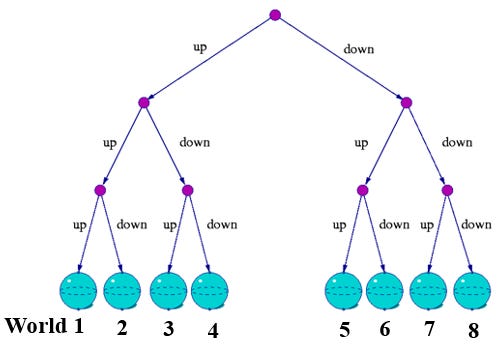
One could extend this reasoning assuming that this may happen not only for a measure of a human observer but for each quantum process at each moment. Therefore, in the MWI, what did not manifest in the past in this world did manifest in some other. In its entirety, the whole Universe realizes all the possible ‘histories’ for which QP allows.
For instance, the source of quantum randomness in this perspective appears to be no randomness at all, as all the possible outcomes come truly into existence. However, we become aware of only one of these outcomes because we find ourselves evolving along the only one of the infinite branches of these myriad worlds where just that result is realized. Deterministic paths do not exist in the single ‘world’ but, rather, in the Universe as a whole.
Quantum superposition also appears to no longer be so mysterious: it amounts to the coexistence of many worlds which, however, cannot communicate or have any physical contact with each other. For example, Schrödinger’s cat is alive in one of these worlds, while it is dead in another parallel world. There is no real superposition of states, only the actualization of both states but each realized in different realities. And, contrary to Bohm’s theory, even locality is recovered.

In fact, entanglement and its non-local character appear only to the observers inside the single world but have no need to exist in the Universe as a whole plurality of these worlds, as the correlations (or anti-correlations) appearing in the experiments with entangled particles exist in the individual worlds, not in the Universe.
The wave function collapse can be interpreted as a branching phenomenon along one tree of the Universe. The collapse is not triggered by the measurement apparatus (and even less by an ‘observer’) but, rather, is something which occurs continuously, as each actual world splits into all the many worlds that the wavefunction predicts at any instant, with the probability representing the relative amount of similarity between one and the other. The wavefunction is real, it has an ontological reality. However, not in one single world where a copy of us dwells, but rather as a universal wavefunction that describes all branches and its worlds at once.
This permanent ‘splitting’ of ourselves into gazillions of Universes parallel to our own every time a state reduction occurs may sound like a quite extravagant hypothesis that is difficult to accept. However, it does explain several weird quantum phenomena and is taken seriously by some physicists. After all, anything that has not been disproven and is, at least in principle, possible according to our current scientific knowledge cannot be dismissed. We are entitled to entertain even the most far-fetched speculations—such as the MWI—as long as they remain unfalsified.
The way I see it…
Yet, I find it one of the most preposterous interpretations ever. It simply doesn’t feel right. Because it pretends to make the unintuitive aspects of quantum mechanics more “intuitive,” but ends up in digging a deeper hole. It tries to explain phenomena that defy everyday experience by conjuring processes that are even stranger, effectively replacing one mystery with an even bigger one.
As I highlighted in my discussion of Bohmian mechanics, I believe the widespread acceptance of the MWI stems less from rational or scientific considerations and more from psychological factors. In my view, the real reason why such an interpretation continues to meet the sympathy of even high-ranking physicists is that, apart from the annoying multiplication of worlds, it satisfies the desire to maintain an anthropocentric view of reality in the frame of an at least partially Newtonian clockwork mechanical worldview describing reality in terms of particles, actual trajectories, and classical deterministic causes and effects. And, after almost seven decades of debates, the MWI remains wild speculation that didn’t produce any tangible advances in QM. The time has come to look beyond!
The subscription to “Quantum Physics: An Overview of a Weird World” is free. However, if you find value in my posts and would like to support my work, you can make a small financial contribution by buying me one or more coffees. You can also support me by ordering one of my books or follow one of my online courses. Thank you in advance!
The principle of sufficient causation holds that nothing happens without a reason.
Every event or fact must have an explanation for why it occurs in the way it does.
This principle underlies many philosophical and scientific approaches to understanding reality. The principle has deep roots in Western philosophy, though it's most closely associated with Leibniz and his Principle of Sufficient Reason.
This type of ‘Universe’ as a collection of many ‘worlds’ should not be confused with the modern ‘Multiverse’ theories so in fashion nowadays.