
Even More Evidence for Particles- Book Excerpt #7
The Franck-Hertz Experiment, Compton Scattering and Pair Production

This is section II.4 (that builds upon the previous sections here) of the first volume of my book, “Quantum Physics: An Overview of a Weird World.” I plan to post regular updates, including minor and substantial revisions, on Substack. For the full table of contents and guidance on how to follow the book as it unfolds, please click here.
Another nice and clear-cut piece of experimental evidence that atoms must have discrete energy levels came only a year later, from the Franck-Hertz experiment. G. L. Hertz was the nephew of H. R. Hertz, the German physicist mentioned as the discoverer of the photoelectric effect. While H. R. Hertz, among other things, proved the existence of EM waves, G. L. Hertz and James Franck were awarded the 1925 Nobel Prize in physics “for their discovery of the laws governing the impact of an electron upon an atom,” using the experiment we are going to describe.
The experimental setup (see Fig. 2) consists of mercury (Hg) gas atoms
inside a low-pressure bulb. An electric cathode—that is, something like the
heated filament of a light bulb—emits electrons. Therefore, this part of the
device emits not only light but also negatively charged particles. An electric
field is applied between the electron emitting cathode and a positively poled
grating, with a battery or some other electric source, which builds up an
electric potential.
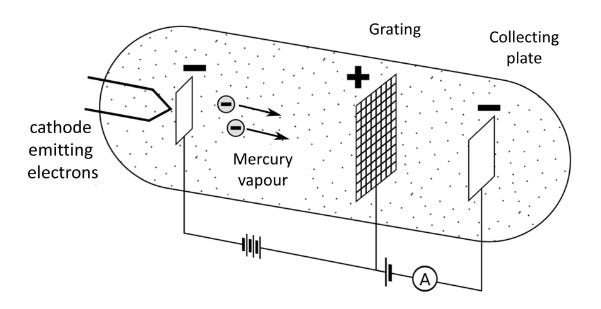
Due to their negative charge, this difference in the electric potential field leads to the electrons’ acceleration and conveys to them some kinetic energy (as you might recall from school, charges with the same polarity repel each other whereas those with opposite polarity attract each other). When the electrons reach the grating, most of them will fly through because the mesh of the grating is kept sufficiently wide to allow for that. This first part functioned as a little electron accelerator. Then, between the grating and a collecting plate on the right side, another field is applied.
However, in this second part of their journey, they will experience an inversely polarized electric field as, after passing the grating, they will be repelled because they will begin to “feel” the negatively charged collecting plate. This means that, through use of an Amperemeter, a device which measures electric current (the number of electrons), one can measure the flux of electrons which flow between the grating and the collecting plate. While the electrons initial energy is proportional to the applied electric field intensity (the voltage) between the emitting cathode and the grating, in this second part, they are decelerated due to the opposite polarity. The measurement of the current, therefore, allows one to determine the number of electrons that make it through to the collecting plate, which provides information about how their energy is affected by the atoms while flying through the gas in this second part of the bulb. This is done by varying that field, step by step, for several voltages.
Franck and Hertz’s insight was that, while flying through the gas of atoms, several electrons must sooner or later hit one or more atoms and be scattered either elastically or inelastically. Elastic scattering means that when objects hit a target, they change course but maintain the same kinetic energy, while inelastic scattering implies that they lose part or all of their kinetic energy in the collision process. It follows that there must be a measurable difference between the energy of the injected electrons reaching the grating and the energy of those which flew through the gas, hitting the collecting plate. This difference is made clear to the observer by measuring the current between the grating and the collecting plate. This energy gap tells us something about the energy absorbed by the atoms in the gas.
Therefore, if atoms absorb energy only in the form of quanta, this implies that, while we slowly increase the kinetic energy of the injected electrons, we should be able to observe when and to what degree the electrons’ energy is absorbed by the gas of Hg atoms.
This is, indeed, what happens, as can be observed in the graph of Fig. 3. While the injected electrons kinetic energy is increased steadily by application of an electric potential from 0 to about 15 V between the cathode and the grating (horizontal axis), the current of the electrons measured at the collecting plate (vertical axis) increases accordingly, though not in a linear fashion. We observe that the electrons do not have a final kinetic energy which increases proportionally to the electrons’ input energy, according to what one would expect for an elastic scattering between classical objects (think, for example, of billiard balls). What we see instead is that at first (between 0 and 4 V), the relation between the input and output energy is approximately linear, which means that the electrons are scattered through the gas elastically; they do not lose considerable kinetic energy.
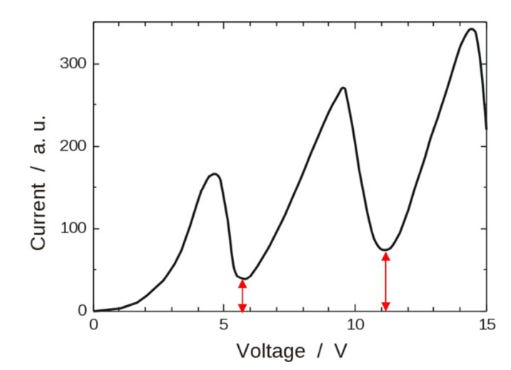
At about 4.5 V, the first bump appears. Between 4 and 5 V, the output energy of the electrons decreases steadily, despite their increasing initial energy. This signals an inelastic scattering: Some of the electrons’ initial energy must have suddenly been absorbed in collisions with the Hg atoms. However, this does not happen before a certain kinetic energy threshold of the electrons hitting the Hg atoms. At about 5.8 V, almost all the kinetic energy is lost and goes into the internal excitation of the atoms. There is, however, a remaining minimum energy gap which is shown in the figure with the vertical arrow. The difference between the first peak and the first minimum is the maximum amount of kinetic energy the atoms are able to absorb from the electrons. Therefore, it furnishes the first excited energy level of the Hg atom.
Then, after about 6-9 V, the energy begins to increase again, meaning that the atoms absorb only that aforementioned discrete amount of the electrons energy, but not more than that. The remaining energy goes again into elastic scattering. All this repeats regularly at about 9-10 V and about 14 V. The existence of these “bumps” at different input energies (until nowadays, experimental particle physics is all about the search for bumps appearing in graphs) means that atoms must have several different but discrete energy levels. Franck-Hertz’s was the first direct experimental proof confirming Planck’s idea that atoms absorb energy in discrete quanta. Moreover, this validated the discrete spectral lines of light spectra, as did Bohr’s idea of representing the atoms in the form of a model which resembles a tiny solar system—that is, with electrons moving only in specific orbits with their respective quantum numbers which represent different but discrete energy levels.
Not too many years later, other types of phenomena confirmed energy quantization in Nature. One of these, in 1923, was the Compton scattering or Compton effect, documented by the American physicist A.H. Compton. Compton also started from the assumption that EM waves could be considered a flux of light particles. If this were true, it would then be possible to calculate precisely the scattering process between a single photon and an electron, just like it is possible to describe the elastic collisions between two billiard balls, using the simple laws of energy and momentum conservation of CP.
Now, by using these conservation laws, Compton wrote a concise and useful formula which relates the wavelength λ of an incoming high-energy gamma-ray photon (a photon with a wavelength sufficiently small to be comparable to the size of an electron) before the scattering with the electron, and the wavelength λ′ of the scattered photon, according to a scattering angle θ (see Fig. 5). The wavelength λ′ of the scattered photon must be larger than that of the incoming one, as it loses some of its energy. This is because the higher the energy of a photon, the smaller its wavelength will be. In fact, recall that the energy of a photon is given by Planck’s relation E = hν, with ν the frequency. The wavelength of an EM wave is given by λ = c/ν , with c = 3 × 10^8 m/s the speed of light in vacuum (ca. 300.000 km/s).1 So, the wavelength we associate with a photon must be inversely proportional to its energy as: E = hν = h c/λ .
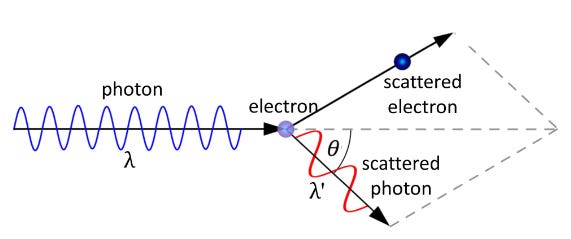
By putting all of this together, Compton was able to predict in 1923 a very strict relation between the difference in wavelength of the incoming and scattered photons and the scattering angle θ, which is the wavelength shift ∆λ radiation undergoes when it is scattered by matter. Compton’s formula was as follows:
Here λ0 is a constant and me is the mass of the scattering particle, in this case the electron. λ0 is called the Compton wavelength, which for the electron is about 2.426 × 10⁻¹²m. Notice that if θ is zero, we have no difference, which means that the photon goes straight through without scattering and frequency change. Whereas for θ=180°, for backscattering, the wavelength increases by twice the Compton wavelength. The exact relation between the input and output wavelengths (or energies) of the particles and their respective scattering angle was verified experimentally, and it turned out that Compton’s predictions came to fruition precisely. This is a great historic example of the triumph of theoretical physics confirmed by experimental verification—of how, in the history of science, we have found that sometimes first comes the math and then comes the verification in the lab (even though sometimes it goes the other way around).
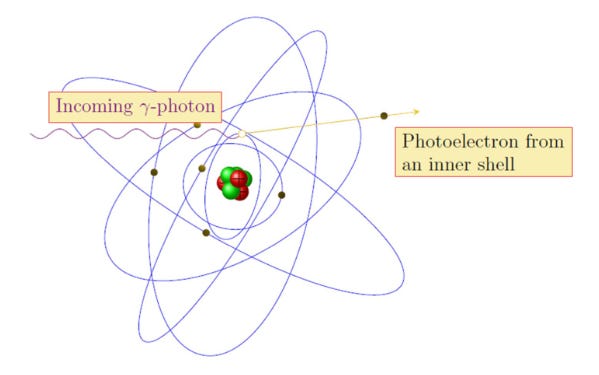
Compton scattering is also an atomic scattering process. This suggests an explanation of how photons can ionize atoms. To ionize an atom means that a photon extracts an electron from an atom’s outer orbit shell around its nucleus. A light particle with sufficiently high frequency can be absorbed by one of the electrons, so that the electron acquires a certain amount of kinetic energy and can eventually be removed by overcoming the atomic force potential that keeps it bound to the nucleus. A gamma-ray photon, however, can be so penetrating that it can ionize even inner electron shells and partially or completely transfer its EM energy to the electron, which acquires the gamma ray’s momentum and kinetic energy and which for this reason is also called a “photoelectron”, something we have already seen with the photoelectric effect). Notice, however, that the photoelectric and the Compton effect are two very different physical processes. The former extracts the electrons from a metal lattice; the latter is a deep scattering process that can “kick out” the electrons which are contained in the inner shells of an atom.
In Fig. 6 you can see an illustration of this process. A single high-energy photon can also be scattered by several atoms and will lose its energy with each repeated collision. A high-energy small-wavelength (high-frequency) photon can become, via multiple scatterings whereby it loses a bit of its energy in each collision, a low-energy large-wavelength (low-frequency) photon.
This is precisely what happens in the center of the Sun. In the Sun’s core, which has a temperature of about 16 million degrees, there is a huge amount of gamma radiation. However, it takes several million years of scattering processes before the photons produced inside the Sun reach its surface, by which time they have lost most of their energy being “downgraded” to the photons that we know as visible light. The light we observe today coming from the Sun’s surface was once an intense radiation foam of gamma photons in the Sun’s interior.
What makes Compton scattering so important and interesting for our considerations here is that all this seems to suggest again that we can reasonably think of EM waves no longer as waves at all, but rather in the context of light particles, or photons, kicking around other particles like tiny billiard balls. If we were to stick to the classical idea that light is made of waves, we should observe a scattering of concentric waves by the electron (think of water waves scattered by an almost point-like object). Compton’s scattering instead indicates that the application of the conservation laws of CP, which determine the scattering between classical particles, holds also with photons. There is therefore no longer any reason to reject a “particle picture” in QM in favor of the “wave picture”.
Another effect which is worth mentioning is the pair creation effect, which can occur as an alternative to Compton scattering. Pair creation is a physical phenomenon whereby a high-energy massless photon is converted into particles with a mass. Instead of the photon and electron being scattered, what occurs in this case is the absorption of the photon (by another particle or atom nucleus) and an immediate release of its energy in the form of material particles.
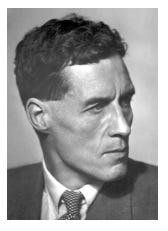
The pair creation effect was discovered in 1933 by the British physicist P. Blackett. This phenomenon clearly shows that we must conceive of light not only as made of photons but also in the context that photons can transform into other material particles, like electrons. Pair creation, or even annihilation, which is the opposite process whereby particles with mass are converted into photons, is a striking example of Einstein’s mass-energy equivalence which is described by his famous formula: E = mc^2 , where m is the rest mass of a particle, and which is called also the “rest energy” (in relativity, the mass of a fast-moving object cannot be handled as the classical rest mass, but we won’t go further into this here) and, again, c is the speed of light.
The mass-energy equivalence tells us that every particle, atom, and any material object with a mass contains an energy in potential form which is given by Einstein’s formula. The fact that it factors in the speed of light squared makes the amount of energy contained in matter huge. Only a gram of matter would cause an explosion like that of the bomb of Hiroshima.
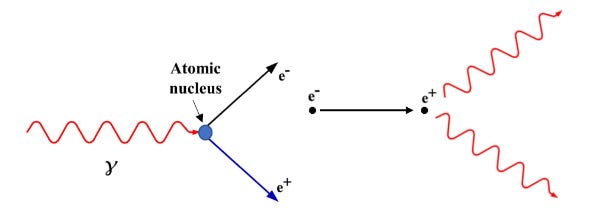
In the case of a gamma photon pair creation (Fig. 8 left), two electrons can “materialize” if a single photon interacts with matter, say a heavy atomic nucleus, and converts into matter itself. One of these material outgoing particles will be the negatively charged electron e−, while the other is a positively charged anti-electron e+, also called a positron.
Anti-matter in general is made of the same particles with the same mass—that is, of electrons, protons, neutrons, etc.—but with the opposite electric charge and opposite spin. This process, however, can only happen if the energy of the incoming photon is sufficiently large to produce the two electrons according to Einstein’s mass-energy equivalence formula. If the photon’s energy is lower than twice the rest energy of two electrons, the process cannot occur and the photon will not be absorbed but instead eventually will be scattered via Compton scattering.
The annihilation process (Fig. 8 right) is the opposite process: Two massive particles (one ordinary and the other an anti-particle) interact with each other and are converted into gamma photons, which subsequently fly apart in opposite directions. For example, if an anti-electron comes into contact with ordinary matter, it annihilates to produce two gamma-photons with an energy given by Einstein’s equation.
Fortunately, for some reason that is still not entirely clear, the Universe we live in is made almost completely of one type of particle; otherwise, we would have already “evaporated away” in a foamy Universe where particles annihilate and create themselves continuously and stars, planets, and of course life, at least as we know it, couldn’t have formed in the first place. In the laboratory, we always observe the creation or annihilation of particles in pairs. The former is always the creation of a particle and an antiparticle, whose electric charges, taken together, sum to zero (positive + negative =zero). We never observe the creation of only one type of particle. This makes sense, because otherwise electric charge would be created out of nothing (resulting in a net positive or negative charge). Yet the universe we observe is composed almost exclusively of one type of matter. Where has the other half gone? At the time of writing, this remains one of the major unsolved problems in modern particle physics.
Thus far, we have listed several phenomena which indicate how energy is absorbed and emitted in a quantized manner and which therefore led to a corpuscular interpretation of light: Blackbody radiation, the photoelectric effect, the Franck-Hertz experiment, the Compton effect, and pair creation and annihilation can all be viewed in this context. So, on one side we saw how light behaves as a wave (recall Young’s double slit experiment); on the other side, EM radiation behaves as if it were made of particles. Which of the two points of view are correct? What is Nature trying to tell us here?
This still isn’t the whole story, as we are going to see in the next article.
At this point, the reader might be somewhat confused by the fact that we are talking about light particles, which are supposed to be point-like objects, and yet we continue to treat them (and even depict them graphically) as waves having a specific wavelength. Again, as we have already seen with the photoelectric effect, Nature seems to play with this ambiguity. It seems as if light, or any EM energy traveling throughout space, can be thought of as a wave and, because matter absorbs and emits it in the form of discrete energy quanta, also as a particle. We shall clarify the deeper meaning of this “duality” in the coming sections. For now, please accept it on faith and follow the line of reasoning and phenomenology of these historical experiments, which became the foundation of all that will be explained later.