
Quantum Mechanics and Consciousness
Myth or Reality?

The Problem with Consciousness
A philosophical problem has plagued philosophers since the 17th century, the time when René Descartes stated, “cogito, ergo sum” – namely, a ‘mind-body problem’ which ultimately boils down to the problem of consciousness. Nowadays, modern neuroscience dismisses Descartes’ ideas about the mind and consciousness. Thinking, being, and perceiving are separate categories that can’t be summarized by a slogan. However, what is particularly noteworthy is that the concept of ‘consciousness’ continues to elude a definition and clear scientific categorization and explanation. Despite the huge amount of data and discoveries of neurophysiology and neuropsychology, driven mainly by technological advances that allowed for the mapping and monitoring of the brain’s activity, when it comes to the so-called ‘hard problem of consciousness’, one can safely say that not much progress has been made in the last four centuries. In modern philosophy, the debate over consciousness was summarized by the Australian philosopher David Chalmers, who distinguished between the easy and hard problems of consciousness. The relatively easy problem of consciousness is that which concerns the explanation of how the brain processes information and environmental stimuli or focuses attention. To specific cognitive functions, one correlates a specific neuronal activity in the brain. This is, so to speak, an ‘easy’ problem because the correlation has been extensively investigated using modern brain measuring and imaging techniques (e.g., electric and magnetic encephalography, neuroimaging with different computer tomography and magnetic resonance methods, etc.).
However, the hard problem has more of a philosophical nature and relates to the question of why a biochemical activity, however complex it may be, should give rise to an experiencing subject that perceives qualities. It looks like a complicated interaction of neurons does give rise to an individual that seems to be a separate “I”, having subjective sensorial perceptions of pain and pleasure and registering colors, smells, tastes, touch, and sounds, which philosophers call ‘qualia’. The information from the environment is not experienced just as a stream of data of abstract bits, as it is encoded in our neural networks, but also as a qualitative phenomenal lived experience. Also, we do not perceive our mental activity as a program running on a set of logical circuits but, rather, as a content of insights that can span a spectrum beyond representations in bits and bytes and that find no parallel in a computer program or any algorithmic structure. Strictly speaking, a materialistic physicalist science should completely reject conscious perception as pseudo-scientific woo-woo and give it no more credence than the existence of unicorns or goblins. This would certainly be the case if not for the fact that scientists can verify by themselves that they are more than a data-crunching robotic zombies. For some unknown reason, we are living organisms that have subjective experiences. If modern science accepts the existence of consciousness, as characterized above by the ability to perceive qualities, it is not because of any empiric external evidence, which is instead completely missing, but only because of an ‘inter-subjective consensus’.
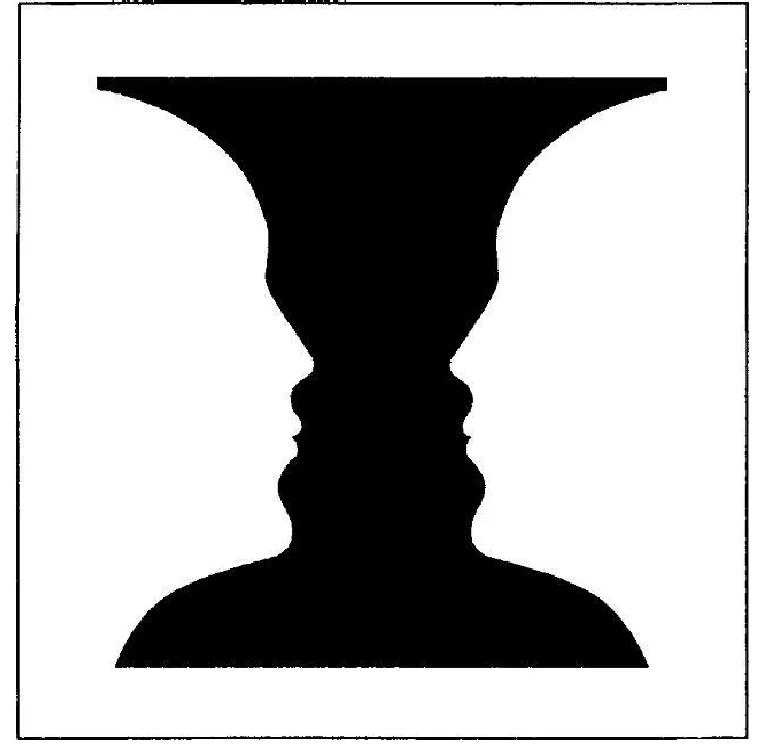
Further, nobody knows how the brain manages to bind its perceptions of thoughts, feelings, and the environment into a unique and undivided whole to which it associates a meaning. This is another problem, called the ‘binding problem’. For instance, when we look at an image, we do not consciously register each pixel one by one and begin to make calculations or ponder on it separately. Instead, we just see, almost instantly, an image to which we associate a unified meaning, being itself a conglomerate of meanings and perceptions at once. For example, when we see the image of a giraffe, we know at once that it is an animal (a categorial meaning) with a long neck (a morphological meaning) and a dark-yellow leopard-like coloring (a chromatic experience). Even if not displayed in the image, we eventually append to it (more or less unconsciously) the environment in which it lives, such as the savanna or a zoo (a mental figure). This is more than the sum of the parts and much more than pattern recognition (something artificial neural networks can already do). Instead, it is about the unified lived experience of a subject that, from a batch of seemingly disordered pixels and other data, suddenly ‘collapses’ it in the perception of the emergence of a meaning which, however, inherently retains a holistic cognition—not just a number or vector in a multidimensional space. The fact that meaning is not inherent in the objects ‘out there’ but must emerge due to the binding skill of our consciousness, is easily recognized through the famous Gestalt figures, in which different meanings could be ‘entangled’, such as those in which we see, at first glance, two faces and then, shortly thereafter, a vase.
Is Quantum Consciousness the Answer?
The fact that these holistic aspects of our cognition are reminiscent of quantum effects, such as quantum entanglement, has led some to conjecture that perhaps quantum coherence, with its indeterministic and non-local aspects, might be secretly at work in our brains. Maybe our brains are, at least partially, like a quantum computer able to process some information all at once.
It was almost inevitable that the conjecture surrounding quantum biology (QB) would sooner or later have been applied to the function of our brains. The human brain is a biological processing unit made of about 100 billion neurons. If QM plays a role in biological cells, and because neurons are nothing other than cells specialized for cognitive functions, it is hard to escape the temptation to extend the potential role of QB to neurons as well.
Moreover, there are also some peculiar aspects that characterize consciousness. For example, it behaves as something which is quite indeterministic and unpredictable. Is our free will real or only an illusion that arises from a complicated biological machine? Or, to put it in the quantum parlance: Are there hidden variables—underlying, unobserved variables that determine the results of measurements—in our brain processes that determine our behavior according to a deterministic view, or are there none and are we really just as free as an electron in the double slit experiment is ‘free’ to choose its interference fringe? The so-called “superdeterminists” such as Stewart Bell or the supporters of Bohmian mechanics would probably tend to believe that there is no free will because, in their interpretation of QM, even the electron’s behavior is predetermined by hidden variables. Others, who accept an indeterministic and non-reductionist view of reality, might be more in favor of the existence of free will. In this latter case, if QM is a truly indeterministic theory without hidden variables, it would naturally explain the unpredictability of conscious behavior beyond a mere manifestation of complexity.
This isn’t a new idea. It is almost a century old. Foundational figures in quantum physics, such as Arthur Eddington, Arthur Compton, and Pascual Jordan, speculated that microscopic quantum stochastic phenomena could be amplified to a macroscopic scale, influencing brain processes.
Jordan was the first to speculate that the unpredictability of life, our behavior, the mind’s apparent indeterminacy could be reconducted to a macroscopic amplification of the chance and unpredictability of the quantum world that is somehow scaled up inside living organisms. He called this the ‘amplifier theory’. The idea is that microscopic quantum indeterminism could also influence macroscopic biology by amplifying the effects of Heisenberg’s uncertainty principle and, thereby, could influence the entire organism.
Nowadays, this amplification theory could be compared to the famous ‘butterfly effect’ in non-linear dynamical systems in which only a tiny difference in the initial conditions of a physical system can cause entirely different behaviors and outcomes in the long term. The typical analogy people use to exemplify this is in weather forecasting and atmosphere dynamics. Say, for example, that a butterfly flaps its wing in one part of the world today; this would determine, in the long term, a completely different weather condition on the other side of the world than that what it would have been if the butterfly had not flapped its wings. This is a well-known extreme sensitivity to the slight modification of the initial conditions of non-linear systems—that is, it is an amplification effect. It is without question that the brain is a strongly non-linear system that inevitably must be sensitive to ‘neural butterfly effects’ as well.
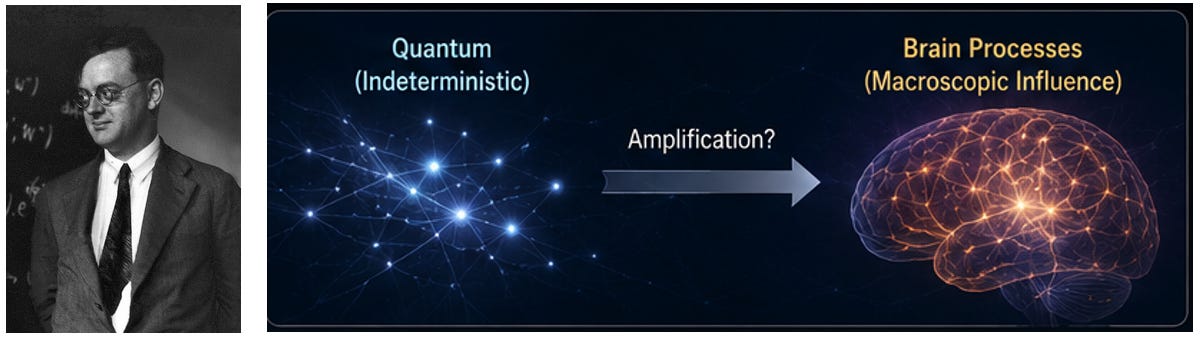
The question is: Does this sensitivity go so far as to also incorporate the quantum effects? In a certain sense, we can be reasonably confident that highly sensitive nonlinear systems are capable of rapidly amplifying microscopic uncertainties, implying that quantum indeterminacy persists across scales. For example, it has been shown that a driven, damped pendulum may exhibit sensitivity to quantum fluctuations down to the Planck scale. While this does not constitute proof that an analogous process occurs in the brain, it nevertheless suggests that quantum-level indeterminacies cannot be ruled out a priori as potentially relevant to neural dynamics.
Why, when discussing the nature and origin of consciousness and mental processes, do some feel compelled to reference quantum indeterminacy? I believe they intuitively recognized that the inherent indeterminacy of the quantum world could provide an answer to escape the idea that we are “lumbering robots,” as Richard Dawkins put it.
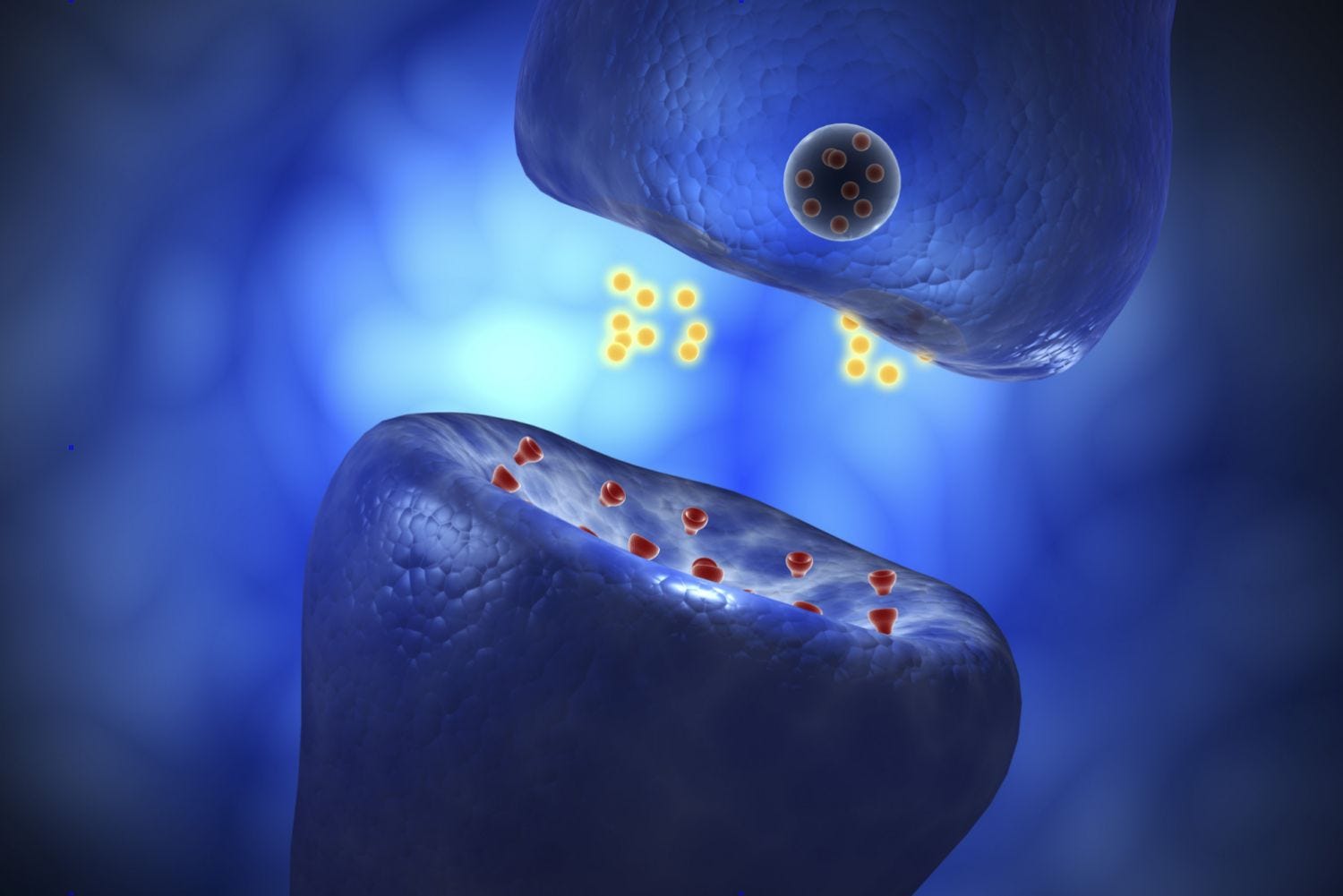
Similar, but somewhat more sophisticated ideas were developed later by Australian neurophysiologist, philosopher and Nobel laureate John Eccles, who suggested that quantum theory plays a role in the workings of the brain as an alternative to a rigid deterministic neurophysiology. In 1994, Eccles claimed that quantum theory enters brain dynamics in connection to cerebral exocytosis–that is, the transport of vesicles filled with neurotransmitters from a nerve terminal into a synapse. Exocytosis is triggered by an action potential build-up caused by the flow of calcium ions through ion channels into the nerve cells. These ion channels are the size of a nanometer and thereby are small enough to be subjected to quantum phenomena. If so, quantum effects are amplified through the exocytosis processes, which determines the workings of the 80-100 billion neurons of all the brain circuitry.
During the same period of time, Henry Stapp, an American mathematical physicist, argued that consciousness might precede matter in being fundamental to the Universe. Our mental processes are, in themselves, due to quantum collapse, while free will is the manifestation of the quantum mechanical effects in the brain. He invoked the quantum Zeno effect—the phenomenon whereby a quantum system's evolution can be slowed or even halted by sufficiently frequent measurements—as evidence that processes can be delayed or modulated in their temporal occurrence by a conscious act. Stapp’s worldview is that of a panpsychist – namely, that consciousness and mind are a primordial property of matter.
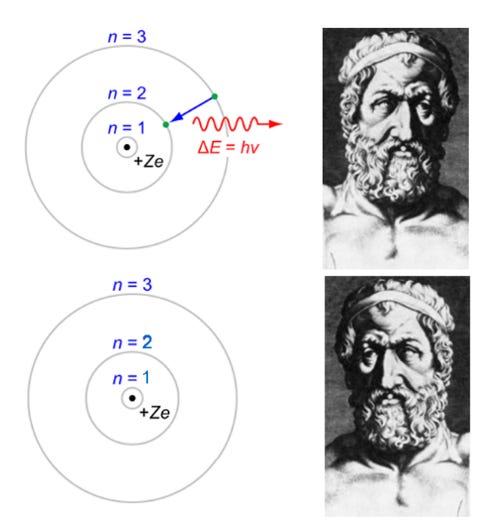
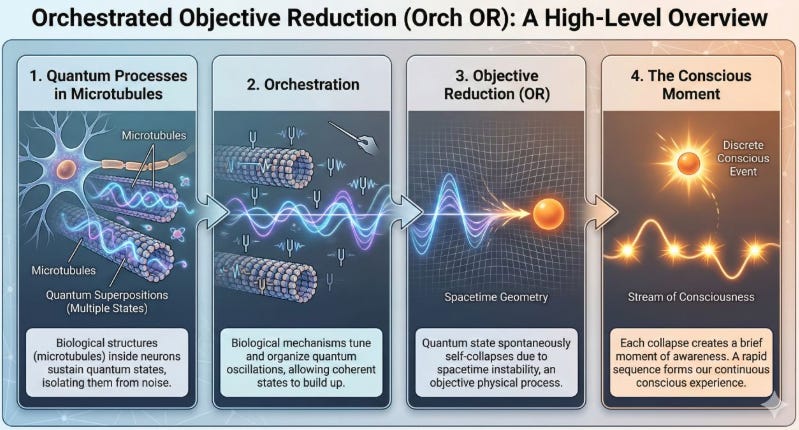
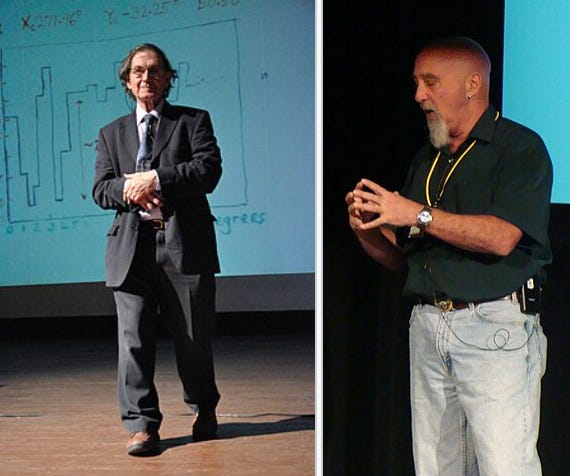
An approach not too different from the wavefunction collapse was taken by the Nobel laureate Roger Penrose and Stuart Hameroff. The theory suggests that consciousness does not arise solely from classical neural computation in the brain but also involves quantum processes occurring within microtubules, cylindrical protein structures found inside neurons. According to Orch-OR, quantum superpositions can develop within microtubules and persist long enough to influence brain activity. These quantum states eventually undergo a fundamental, gravity-related collapse process called objective reduction, as proposed by Penrose. Hameroff and Penrose argue that the orchestrated sequence of such quantum state reductions generates discrete moments of conscious experience, linking the physical processes of the brain with the emergence of subjective awareness. However, the attempts to address the problem of the environmental-induced decoherence, remain largely contested.
More recently, some have proposed that a mechanism similar to that of photosynthesis or magnetoreception and that we saw in the last post, might occur also in and between neurons. There is convincing evidence in support of the fact that some chemical reactions inside cells, with neurons being no exception, are capable of emitting ‘biophotons’ (with the mitochondria being likely sources). We know that the neuron’s activity is mainly of an electric and biochemical nature but light emission might also play a role. We know that light-sensitive proteins exist in the brain and could potentially function as single-photon detectors. Where photons are emitted or absorbed inside living tissue, the same or a similar QB of photosynthesis and magnetoreception might be at work. For instance, some imagine a neural complex entangled state of spins generated through the exchange of photons. Entangled spins and photons are somewhat less susceptible to the thermal decoherence effects which could potentially be a partial solution to the problem posed by the ever-present environmental quantum noise. If Nature is able to provide a mechanism by which the coherence can be preserved for time ranges of a subjective experience (milliseconds to a second), that could potentially furnish an indication.
The Current State of the Debate
These represent only a small selection of the many speculations surrounding the possible connection between QM and consciousness. Many other ideas deserve consideration, but the scope of this short article is simply to introduce the topic and set the stage for further exploration.
All these hypotheses raise many interesting questions in neuroscience, biology, biophysics, and philosophy. However, these are even further than QB from being accepted and established scientific facts. It is not at all clear whether QM and consciousness have something to do with each other, and several scientists dismiss this hypothesis altogether. Again, it is difficult to imagine how that warm grey matter could contain and sustain, even in principle, long-lived phenomena of that extremely fragile phenomenon that is quantum coherence. Few believe that decoherence at room temperatures in such a mushy macroscopic object could be prevented from settling in almost instantly. And the idea that quantum indeterminacy could be amplified to brain-sized scales and play a functional role is regarded as even less plausible by most scientists and philosophers.1
Moreover, most do not feel that it is necessary to invoke QM in the brain because they are interested only in solving the easy problem of consciousness. They see no reason to believe that some cognitive functions couldn’t be explained by the classical laws of physics.
However, the divide is more ideological than scientific in nature. Those who lean toward some sort of dualist, metaphysical, or at least to some non-strictly materialist worldview that doesn’t reduce everything to matter, are generally more willing to consider the possibility that quantum phenomena play a role in brain activity. It is no coincidence that spiritualist New Age movements have extended quantum terminology to almost every aspect of reality. Instead, those who are more inclined toward a physicalist and deterministic view of life, are typically much more skeptical. Some dismiss it altogether as pseudo-science.
We must be aware that the role of QM in the brain is still more a topic discussed in popular magazines than a scientifically established and actively pursued field of research. It is a line of inquiry that receives very limited funding and is therefore often constrained to theoretical and speculative investigations.
Times are changing, however. In recent years, research into quantum consciousness and, in particular, findings from quantum biology suggesting that quantum effects may play a role in biological microstructures have attracted renewed interest. An increasing number of scientists are beginning to take these possibilities seriously. We should hope that this trend continues.
Let us not forget that the history of science has shown that even highly foundational research, which initially appeared to have no practical applications, can eventually prove revolutionary. Not only by reshaping existing paradigms but also by leading to unforeseen practical developments.
If you find my work valuable, I would greatly appreciate your support. You can help me continue by buying me one or more coffees.
Every contribution, big or small, truly means a lot to me—I sincerely mean that. Your support helps me dedicate more time to research, write new articles, and continue creating thoughtful content for this community.
Alternatively, you can…
Thank you for being part of this journey! 🙏
Personally, I consider this to be the most appealing hypothesis. Genuine indeterminacy, in my view, must be an essential ingredient of free will. I find little rationale or logical coherence in the arguments of the so-called “compatibilists” who attempt to reconcile determinism with free will. However, that is another philosophical cup of tea that I will not pursue further here.
This is one of the clearest walkthroughs of the Orch-OR lineage I've read, from Jordan's amplifier theory all the way to Penrose-Hameroff's microtubules. Your footnote on compatibilism is the part that stayed with me — I've never found a version of it that doesn't quietly smuggle determinism back in through the side door. I explore a related angle in my book The Quantum State of the Mind, less focused on proving coherence survives in warm neurons and more on what indeterminacy would mean for consciousness if it does.
There are a lot of distinctions to make between the "res extensa" vs "res cogitans" and the later "mind body problem" and "the hard problem of consciousness". These are not exactly the same problems although they are intimatly related. It is to be notice that this line of problems did not exist previous to new scientific mode of thinking pionnered by Galileo/Descartes/Leibniz/Newton . These problems are a direct consequence of this new scientific mode of thinking and the limit of this new mode of thinking. The problem disapear or is diffused when we recognise the limit of this mode of thinking. The limit is that it correspond to the "it" of our language. Our language as our nervous system makes the foundamental distinction between the "it" (inanimate) and the living/animate. Verbs describe only what animate entities does. The scientific mode of thinking is limited to our handling with the inanimate. These problems emerged under the limitation of the scientific mode of thinking to the inanimate. Thus we needs a living cosmology, one allowing the expression of our full being. If living is methodologically cast out, calling it back in the cemetary of the inanimate will be called problems. The casting out is the problem.