
Quantum Prehistory: Particles, Waves, and Light - Book Excerpt #1
The Question of Light’s Nature

These are the introductory sections (I.1 and I.2) of the first volume of my book, “Quantum Physics: An Overview of a Weird World.” I plan to post regular updates, including minor and substantial revisions, on Substack. Please subscribe to avoid missing the upcoming chapters. Please subscribe to avoid missing the upcoming chapters. For the full table of contents and guidance on how to follow the book as it unfolds, please click here.
Since the days of ancient Greece, natural philosophers have inquired into the physical nature of light. What exactly is light? Where does it come from? How is it emitted and absorbed? One of the most challenging sets of questions that has kept many bright minds busy to this day is: What is light made of? Is it made of “light particles,” as water waves are made of water molecules? Or is it a wave? If it is a wave, then a wave of what, and traveling through what? Or is it both a wave and a particle? Or is it something entirely different? These are questions that, somewhat surprisingly, still have no definitive answers, as we will see.
Democritus regarded light as a stream of particles. Lucretius agreed, writing: “The light and heat of the sun: these are composed of minute atoms which, when they are shoved off, lose no time in shooting across the interspace of air in the direction imparted by the shove.” Aristotle declared that “the essence of light is white color and colors are made up of a mixture of lightness and darkness.” In De Anima (II.7) he famously defines light as “the actuality of the transparent as transparent.” In other words, light for Aristotle is not a stream of particles traveling through space but the actualized state of a transparent medium such as air or water when illuminated by a luminous body. In that respect his account is closer to a kind of field-like conception than to the atomistic emission theories of Democritus.
In hindsight, this wasn’t a bad guess. Wasn’t it? Interestingly, the idea of light being a mixture of lightness and darkness was taken up later by J.W. von Goethe, a German writer, poet and natural philosopher living in the 18th-century. Goethe constructed a theory of light that indeed works. He conceived light as not being something fundamental but something that emerges from a (from the German {”Urphänomen”}).
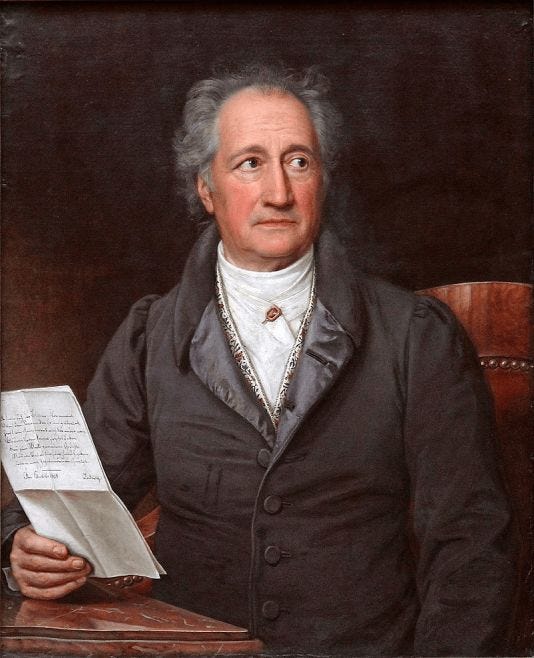
This primordial phenomenon can be observed at the boundary between light and darkness. In this formulation, colors never arise from light alone but as consequence of a dark/light or a black/white contrast at boundaries, edges, and slits. This interesting theory, on its own, could not be disproven and is, in principle, still valid. I would recommend everyone interested in the history and philosophy of science to analyze Goethe’s approach. It might still have something to teach us as it explains light, darkness, and colors from a qualitative standpoint, and, in some respects, could be considered a complementary understanding to the modern physical quantitative approach.
However, Goethe’s theory of colors, being a purely qualitative theory, cannot make quantitative predictions as a modern quantitative science – like physics – needs to be able to do. Goethe tried to challenge the theory of Sir Isaac Newton, the famous English physicist, mathematician and astronomer, better known for his law of universal gravitation, who was able to separate white light into its colored components using an optical prism. But more relevant for our purpose was Newton’s light particle theory. According to this conception, light is a flux of “colored particles.”
At the time, this was not much more than speculation; it was not a real understanding coming from conclusive investigation. In fact, Christian Huygens, a Dutch mathematician, physicist and astronomer, did not share Newton’s idea and argued to the contrary, that light is, in fact, a wave.
For a significant amount of time, there were heated debates regarding which theory was correct. In fact, it was difficult to imagine light as made of particles and, at the same time, being a wave. One theory must be true, but both being true was considered to be a logical impossibility.
In 1803, a groundbreaking discovery seemingly settled the issue for over a century. Thomas Young, an English physician, performed a revolutionary experiment we will examine later, the well-known double-slit experiment. He first showed that when light is emitted by a point source and is directed through a card with two tiny pinholes, a colored interference pattern appears on a screen positioned at an appropriate distance on the other side of the card with the pinholes. Later, the same experiment was performed with two slits instead of pinholes. How waves add or subtract each other, resulting in an interference pattern, was something that was already well-known and accurately studied with mechanical waves, typically oscillating pendulums, or water waves. Since light was shown to exhibit the same characteristic behavior in the double-slit experiment, this seemed to finally prove the wave theory of light vs. the particle interpretation beyond any reasonable doubt.
Further insight on the nature of light came from the work of James Clerk Maxwell, a Scottish theoretical physicist, who predicted the existence of electromagnetic (EM) waves. In 1864, he wrote his famous equations —Maxwell’s equations—, which are the mathematical foundation for modern electromagnetism (also called classical electrodynamics). These are a set of four elegant equations that are very general and hold for all EM waves.
The connection between light and electricity as magnetic phenomena became clear as an obvious consequence of the fact that electric and magnetic fields propagate with the same speed of light. So, the issue seemed to have been settled once and for all. Light must be an oscillating electric and magnetic field propagating throughout space like a wave. Maxwell’s equations were accepted as the ultimate description EM waves.
One problem still remained, however: what is the medium through which light is supposed to travel? Water waves, sound waves or material waves use respectively water, air or a solid body as a support through which they can propagate. Without water or air or matter in some form, there can be no transmission of mechanical waves. Since light can travel through empty space, this led naturally to the question whether empty space were made of some subtle, yet unknown luminiferous aether that could function as a medium for EM waves. These ruminations kept the young Albert Einstein busy while he was working in a Swiss patent office and led him to his famous theory of relativity. He posited that there is no aether (without even knowing that this had already been shown experimentally) and drew from that the conclusion that made him world-famous: the theory of special relativity (SR).
The idea that empty space is not made of some immaterial substance that offers light a transmission medium has held until today, and no longer causes much debate. Nonetheless, as we shall see, our conception of light being a wave and not a flux of particles will turn out to be in need of much further and deeper clarification and analysis.
However, before continuing in our historical analysis of the development of the nature of light, it is necessary to introduce an interlude that sets the conceptual foundations. Nothing can be said in QP if we do not have a clear and rigorous understanding of how waves and their characteristic interference phenomena are described in physics.
Patterns of Light and Shadow: The Physics of Waves and Interference
So, what is interference? It is extremely important that you understand at least intuitively what this is about. There is virtually nothing in QP that isn’t related, directly or indirectly, to interference. Without the wave-description and the interference of oscillatory phenomena, almost nothing can be said in QP.
Let us first of all see how light is conceived of as an oscillating EM field. To see what a field in physics is, the example of a force field like that of gravity might be more illustrative since we know that better from our everyday experience. The gravitational field that surrounds a planet like the Earth is a region of space where gravity acts upon material bodies. The moon interacts with the Earth’s gravitational field and also the reverse is true; that is, the Earth “experiences” a force originating from the gravitational field of the Moon. Also, other forces acting upon objects exist, namely electric and magnetic forces, the actions of which on the surrounding space can be visualized with the field notion as well. What distinguishes EM forces from gravity is that the former can be both attractive and repulsive—in contrast to the latter, which can be only attractive. Electric and magnetic forces are therefore characterized by a polarity (positive and negative electric charges, north and south magnetic poles).
A detailed description of these fields would require a lengthy elaboration that is not essential for our purposes here. It need only be highlighted that a moving electric charge always produces a magnetic field (say, an electric current in a wire—which is nothing other than a huge amount of electrons in motion—will always create a magnetic field whose lines are concentric to the wire). And, when an electric field changes in time, for instance a periodically oscillating electric field caused by an electric charge oscillating in space, this always induces a corresponding oscillating magnetic field. The reverse is also true: an oscillating magnetic field always gives rise to a corresponding oscillating electric field. The two never exist separately when one or the other varies in time. This is the reason why physicists speak of oscillating EM fields, unifying the concept of electricity and magnetism in a unique and inseparable physical entity, a concept that is central in Maxwell’s equations.
This can be visualized with an electric and magnetic component oscillating in time and traveling in space up to the speed of light. Electric and magnetic forces have a direction and a magnitude, and for this reason are represented graphically as arrows, the lengths of which indicate the magnitude of the field in each point of space and its direction in the orientation of the acting force.
Mathematically, one represents these “arrows” by vectors. As it has become a convention, the vector of the electric force is labeled “E” and that of the magnetic one is labeled “B”. Formally, each component of an EM field can be represented by a function of these vectors changing in time while moving along the z-direction.
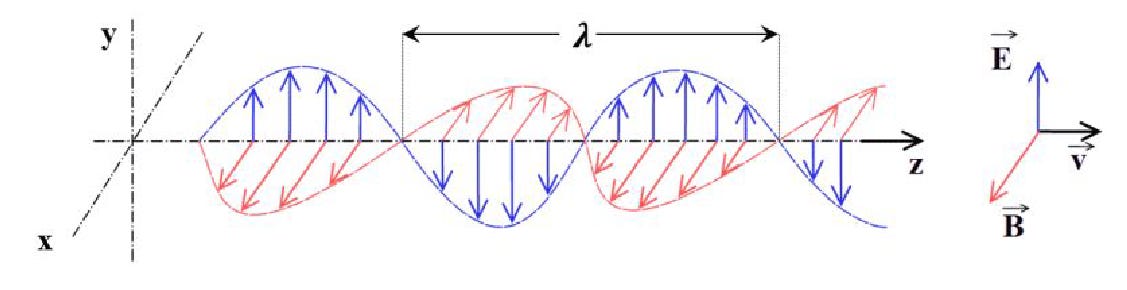
The oscillation plane of the electric field (in the figure, the vertical E-B plane) determines the so-called polarization plane of the wave. Remember always that two waves can have the same wavelength (or frequency) and the same direction of propagation but different polarizations. The orientation of this plane determines the orientation of the polarization. In this case we have vertical polarization but, of course, any other orientation is possible, as the horizontal one or any other in between (more on this later).
It can be shown that, since the electric field is a result of a changing magnetic field in time, and vice versa, the electric vector must always be perpendicular to the magnetic one. And, as you can see, to this oscillatory field we can associate a wavelength λ (”lambda”), which is the measure of the “wave’s size” or, more precisely, the length between two identical field vectors with the same amplitude and direction, or to put it more simply, twice the distance between two points where the field is instantaneously zero. Mathematically it is just the speed of propagation of the wave c, divided by the number of cycles, that is, its frequency ν (”nu”). So, in general:
Now, how do we know that light is, or behaves like, a wave? Well, it is because of interference phenomena. To illustrate this, let us take two overlapping waves which have the same amplitude and are in phase, as in the Fig.5a (to keep it simple, we assume the polarization to be the same as well). Here, the peak or valley values (say, of the electric field) of one wave are coincidental in time and space with the peak and valley values of another wave. In this case we will have a peak-to-peak superposition, and they will sum up to form a single wave with larger amplitude. This is called constructive interference.
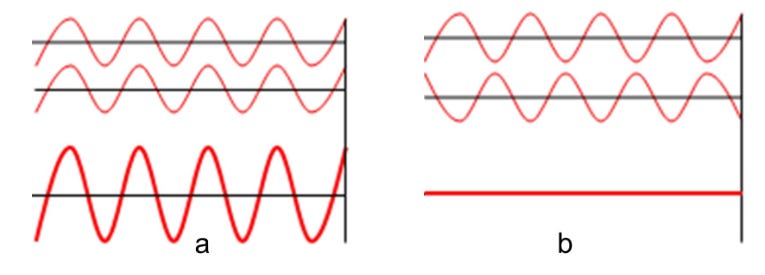
In the case of the opposite situation of Fig. 5b—that of two overlapping waves with the same amplitude, but in anti-phase—then one has a peak-to-valley superposition, whereby the two waves cancel out each other and the resulting signal will be zero. This is called destructive interference.
In a situation which demonstrates the in-between of constructive and destructive interference, where two or more waves with different amplitudes and phases come together and interfere to produce a somewhat fuzzy superposition of waves, you will of course get a less regular and ordered signal.
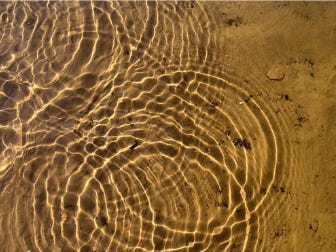
A typical example of this is what you observe when you throw two or more stones into a pond (Fig.6). You get a pattern where you have some places where the waves add up, others where they subtract from each other, and still others where they interfere in other ways. We will look at another example of this soon.
We are now in a position to properly describe interference phenomena. Let us address the question of precisely how intersecting waves add to or subtract from each other. Using the Greek symbol for the amplitude of a wave at position x at time t, which is written ψ(x, t) generally (read: “psai of x and t”), let us add two waves with functions ψ_1(x, t) and ψ_2(x, t). These could be representative of the amplitude of the electric or magnetic field of two light beams. To keep things simple let us consider the case of two waves with a different frequency but with the same amplitude, as in Fig.7 top.
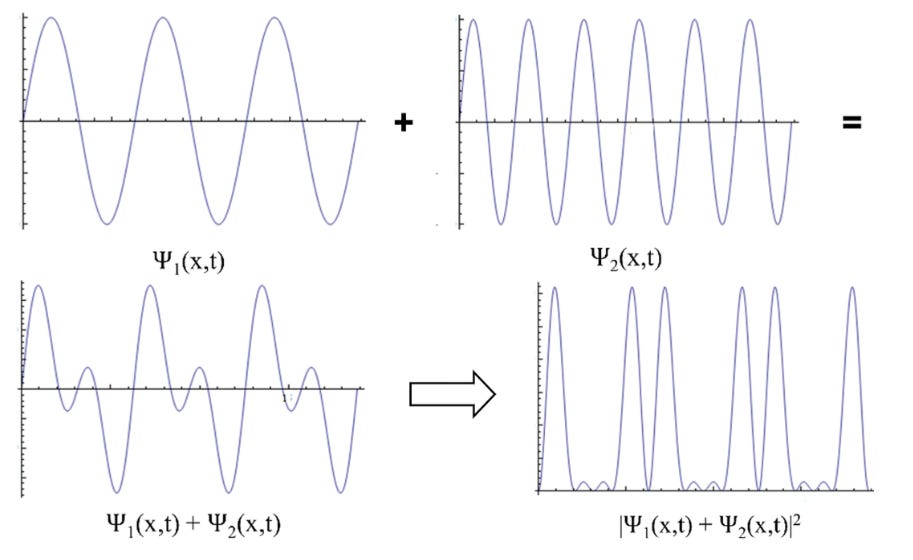
We won’t go into the calculations, but one can show how, with the above described mathematical structure, the interference resulting from the superposition of both fields looks like the resulting signal of the lower left-hand depiction in Fig. 7. This function still has negative values and therefore would make no sense as a measure of the intensity of the light resulting from this overlap. A negative intensity would be a meaningless concept in physics. Therefore, what one does is to square these values, since the square of any number, be it positive or negative, always gives a positive value.1 And this is what is done in physics to obtain a light intensity measurement from the EM oscillatory field it represents. So, taking the squared modulus of the sum of these fields leads to the lower right-hand side interference pattern. The squared modulus is used because the two functions are usually represented by complex numbers).
As you can see, for this particular case, one obtains two kinds of intensity maxima, some small and the other much larger, which are arranged alternatively along the horizontal x-axis. Keep in mind that this pattern results only for a particular time t. In reality these peaks oscillate, changing their intensity with passing time. But for light, this oscillatory movement is so extremely fast that it is undetectable—even for the most advanced modern measuring devices (e.g., the frequency of yellow light is about 5 x 10^{14} Hz, which is 500,000 billion oscillations per second). Therefore, since the oscillatory phenomenon of the electric and magnetic fields of light occur on a time scale well beyond the measurable domain, for most practical applications one can just use the average intensity, which turns out to be a very good approximation. That’s why we will frequently skip the time parameter in the wave description and simply write them as waves with their spatial dependence without the time parameter, as Ψ(x).
The important message to relay here is that of how waves interfere and that their intensity results in constructive and destructive interference patterns. You should develop at least a clear intuitive understanding of the interference phenomenon described above, because it forms the backbone of quantum mechanics and is something we will encounter repeatedly.
Building on what we have learned so far, the next article will examine the famous double-slit experiment in its classical version.
It’s not simple as that. One might reasonably ask why one should not instead adopt the fourth, sixth, or any other even power of Ψ, all of which would likewise preserve positivity. Remarkably, this apparently innocuous mathematical detail has yet to receive a fully definitive answer, as we shall see. For the moment, simply accept the modulus-squared prescription—better known in QM as the Born Rule.
Very cool, thank you! — especially the openness toward Goethe’s approach, which is rarely treated sympathetically...
One small historical note: Aristotle did not actually hold a particle theory of light. In De Anima (II.7) he famously defines light as “the actuality of the transparent as transparent.” In other words, light for Aristotle is not a stream of particles traveling through space but the actualized state of a transparent medium such as air or water when illuminated by a luminous body. In that respect his account is closer to a kind of field-like conception than to the atomistic emission theories of Democritus.
On Goethe: the characterization of his color theory as purely qualitative is understandable I think, but recent experimental work has complicated that picture. Physicists such as Matthias Rang and collaborators have reconstructed Goethe’s prism experiments and shown that the boundary spectra Goethe described at light–dark edges correspond to real optical phenomena that can be modeled quantitatively, not only the phenomenal aspect of it. Goethe himself did not develop a mathematical theory, but the phenomena he investigated are experimentally robust and analyzable within modern optics. Check this out: https://www.researchgate.net/publication/357993666_Goethe%27s_Farbenlehre_from_the_Perspective_of_Modern_Physics. Also: https://philpapers.org/archive/MUEPE.pdf?utm