
Waves strike back again - Book Excerpt #10
Bohr's atomic model revised

This is section II.5 (that builds upon the previous section here) of the first volume of my book, “Quantum Physics: An Overview of a Weird World.” I plan to post regular updates, including minor and substantial revisions, on Substack. For the full table of contents and guidance on how to follow the book as it unfolds, please click here.
The de Broglie hypothesis unifies the wave and particle nature of both light and material particles, proposing that all particles can be described as localized wave packets whose wavelength is inversely proportional to their momentum. This concept explains phenomena from X-ray diffraction in crystals to the dual behavior observed in electrons and photons, laying the foundation for understanding atoms as matter waves.
In fact, if we understand electrons not as tiny localized point-like particles which orbit around the atomic nucleus, but as matter waves, that is, waves distributed concentrically around the orbit, it becomes quite natural and intuitive to understand why the energy levels of atoms must be quantized.
Recall the standing wave we already discussed for the blackbody cavity. Here the principle is the same, but instead of reflections of a wave on a cavity wall, the wave circulates along an atomic orbit and for the same reason allows only for specific oscillating modes for constructive interference to exist. If this matter wave has a wavelength which does not match and reconnect to itself again at the same point along the orbital path (see the diagram of Fig. 1) and if the circumference of the atomic orbit of the electron (the circle) is not exactly an integer multiple of the electron’s wavelength (the wavy line), then constructive interference with itself is no longer possible, destructive interference disallows stable patterns, and the wave packet distributed around the atomic nucleus cannot build up as a standing wave structure.
The classical notion of orbital velocity of the electrons around the nucleus is fixed by the fact that the electrostatic attractive forces between the positive charge of the nucleus and the negative one of the electron must be balanced by the centrifugal forces, and which keep the electron in orbit and which are given by its distance from the nucleus. But this distance cannot be an arbitrary one; the velocity of the electron, which determines the wavelength of the electron (due to de Broglie’s relation relation ), must match just that orbital distance where constructive interference occurs and is equal to just that speed which is enough to keep the electron in a stable circular orbit.
It is possible to calculate this, and indeed it turns out that the electron will distribute itself naturally only on well-defined, discrete orbits. For the simple case of the hydrogen atom, this can be calculated with relatively simple algebra and CP concepts plus the de Broglie relation.
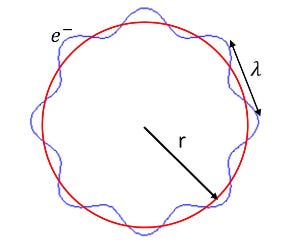
And voilà, it turns out that only those matter standing waves are allowed to exist which match the quantized energy levels experimentally observed in the hydrogen atomic spectrum (see Fig. 6). Bohr’s atomic model added with the de Broglie hypothesis seemed therefore to gain credibility, since it explained naturally why atomic levels are quantized. Still, as we already pointed out, it does not explain the spectra of all the other elements.
So, let us turn back to Bragg diffraction and clarify what we really mean by “matter waves”. Since we can conceive both material particles, like electrons, and massless particles, like photons, as waves, and since we observed the Bragg diffraction for EM waves, as was shown for photons in the X-ray spectrum, the question at this point is: Does the Bragg diffraction hold equally also for material particles? Is it conceivable that tiny chunks of matter like electrons, neutrons, protons, or whichever massive particles can be diffracted by the lattice of a crystalline substance and display the nice interference patterns as has been observed with light waves and X-rays?
To check this idea one must send no longer photons, but instead material particles—say, electrons or neutrons—into the crystal lattice by modulating its energy, that is, its momentum (its speed). In fact, by doing so, one modulates, according to the de Broglie relation, its wavelength as well. If the wavelength of the wave packet matches the size of the crystallographic planes’ separation, one should expect the interference patterns.
This experiment was conducted in 1927 by the American physicists L. Germer and C. Davisson, and independently also by the British physicist G.P. Thomson. Passing a beam of electrons through a thin film of metal, they observed how electrons are subjected to the exact same interference laws that photons are. What they found were indeed the Bragg diffraction patterns, like those of Fig. 3.
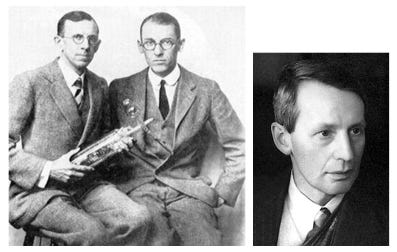
So, when subjected to appropriate physical conditions, what was imagined to be rock-solid chunks of matter displayed a wave-like nature. This was an experimental verification of the de Broglie hypothesis, which at this point was no longer a hypothesis at all but an experimental fact: The observed interference pattern corresponded exactly to those expected if we adopt the de Broglie relation. This is a universal property of Nature—which, however, is not at all intuitive.
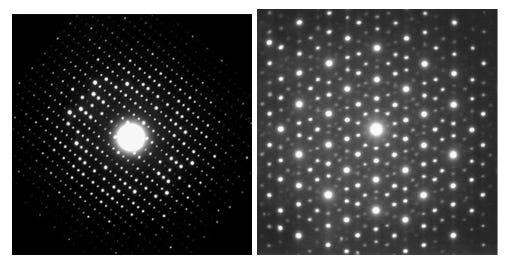
From the abstract mathematical point of view everything is clear and is nicely quantified and experimentally measured as described by theory. But from the more ontological perspective things are not that clear. The question is: What are these particles or matter waves really, at the microscopic level? Are they particles, waves, something which should be conceived as a synthesis of both, or something else entirely? It is here that the philosophical journey of QM began, and this led then to the famous wave-particle duality, Heisenberg’s uncertainty principle, the concept of the wave function, and so forth, as we will explore in the following sections.
This concludes chapter II of my book. The table of contents you can see here.
The next chapter will deal with the first foundations of quantum physics, starting from the wave-particle duality, then proceeding with Heisenberg’s uncertainty principle, the wave function and its ‘collapse’, the state vector and Schrödinger’s equation, and the particle in a box as the basis for atomic physics. Stay tuned and subscribe!