
The Wave-Particle Duality Revisted - Book Excerpt #11
The Wave-Particle Duality

This is section III.1 (that builds upon the previous section here) of the first volume of my book, “Quantum Physics: An Overview of a Weird World.” I plan to post regular updates, including minor and substantial revisions, on Substack. For the full table of contents and guidance on how to follow the book as it unfolds, please click here.
Almost everyone has heard of the famous “wave-particle duality” , but there are unfortunately many misconceptions surrounding it. One of the most frequent sounds more or less like this: “A particle can be sometimes a wave or a particle, depending on the observer.” This is a misleading waxy to present a much more subtler and more interesting phenomenon. Firstly, one should speaks instead of a particle that acts like a wave. Secondly, it is high time to debunk the “observer myth” in QP. No quantum phenomenon needs a human mind or consciousness observing it to validate its existence, and there is no “wave-to-particle” or “particle-to-wave transmutation” in the sense that our naive intuition tends to suggest. It is no coincidence that we are presenting wave-particle duality to the reader after dwelling first on a historical and conceptual introduction in order to furnish the context with which to grasp the deeper meaning and implications of the theory. We will do the same for Heisenberg’s uncertainty principle in the next section.
We have seen that photons can behave either as waves or as particles, according to the context and the experimental arrangement. For instance, the photoelectric effect or the Compton effect gives one answer, and the double slit experiment and Bragg diffraction give the opposite one. In the latter case we have also seen how the wave character fits with material particles too, like electrons or neutrons.
However, we might ask at this point: When, how, and under which circumstances does the one or the other aspect arise? Is this a property that quantum objects acquire switching from one state to another? Is there somehow a moment in time where a somehow ill-defined entity is or behaves like a particle and afterwards morphs into a wave? If so, does this happen in a continuous fashion, or instantly? Or is there another possible interpretation and understanding which unites the two aspects of photons, as waves and as matter and energy?
In some sense we have already seen how, with the de Broglie hypothesis, it is possible to unify this disparity with the concept of the wave packet. Therefore, so far we have shed some light (pun intended) on this wave-particle duality, but the picture is still somewhat incomplete. Because, if we think about it carefully, nobody has observed a light wave in the way we can observe a water wave. What we always observe are the effects of something that we imagine, by deduction after the fact, to be something that acts like a wave. The several experiments that hinted at the particle- or wave-character of light did not show that light is a particle or is a wave, but that it behaves like a particle or a wave. We should not confuse our human mental (sometimes even ideological) projections of how reality appears, with reality itself.
It is here where Young’s famous double slit experiment comes into play again in its modern quantum version. It clarifies further some very important aspects and clarifies the nature of physical objects in quantum physics.
So, let us turn back to the transverse plane wavefront of light (see Fig. 1), say, just a beam of light coming from a source which ideally is highly monochromatic, that is, having a single or very narrow range of wavelengths and colors (nowadays an easy task to accomplish with laser light).
We know that the slits should have a size and separation which should be comparable with that of the wavelength of the incoming light (something which, even for small wavelengths, can be achieved with high precision using modern lithographic technologies). When the plane wave goes through these slits it is diffracted and is detected with a screen at some distance, and the usual resulting interference pattern appears. These fringes can be easily photographed with a photographic plate or a CCD camera or whatever kind of sensor sensitive to the wavelength we are working with.
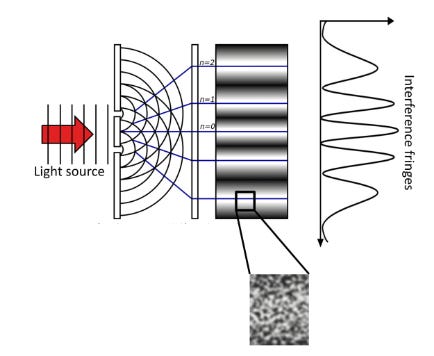
Through Young’s experiment, the question about the nature of light seemed to receive a clear answer. We conceive of light as a wave since it behaves like a wave, due to displaying the interference phenomenon typical to waves.
The (more or less unconscious) logical background of this conclusion relies on what is called the duck test of abductive or retro-ductive reasoning: “If it looks like a duck, swims like a duck, and quacks like a duck, then it probably is a duck”. This is a funny way to describe what philosophers mean with the technical term of counterfactual definiteness—that is, the ability to assume the existence of an object and its properties even when they have not been measured directly.
However, upon closer inspection at the microscopic level, the double slit experiment turns out to be just an upside-down view of the larger story. How so? Because what we detect are always and only interactions between the light and the detector screen in tiny localized spots. What one observes locally is not some nice continuous shading of the intensity between the black and white fringes, but instead a random distribution of points, that is, of point-like localized interactions on the detector screen, just like pixels on a monitor.
For instance, if we use an old conventional photographic plate as our detector screen, develop it, and then look at the photograph under a microscope (magnifying the region of the interference pattern in Fig. 1), we see many tiny white spots which correspond to the grains that, due to a chemical reaction, become white if a photon is absorbed.
After all, when we make a measurement, what we ultimately observe are particles, not waves. Be it a photographic plate, a modern CCD-sensor, or any other kind of detector which responds to an electric signal or just “clicks” (like a photodiode or a photomultiplier), what we really measure are one or many dots, local point-like interactions which form a granular interference pattern, never a continuous pattern. Even if we were to build a detector with the highest resolution possible—say, every pixel is an atom—the same dotted interference pattern would emerge at smaller scales. This should not come as a surprise, since from what we have already learned about the blackbody radiation theory and atomic transition spectra, we know that matter, and therefore atoms and molecules, absorb “quanta” not in a continuous fashion but rather in the form of discrete amounts of energy.
Therefore, also in Young’s experiment, we recover and find again the corpuscular nature of light: What seems to be diffracted at the slits and interferes on the screen behaves like a wave, but what is finally observed are photons hitting the screen. On one side, we have something we imagine (we don’t see it) to be a wave that goes through the double slits; but when we attempt to detect it, it inevitably shows up as a localized interaction.
In a certain sense we find ourselves again at the starting point. What is a photon really? If it is a wave, why, when, and how does it become a particle in order to be detected as a point-like structure?
Let us further inspect this state of affairs. If we would strictly maintain the particle picture, then we must assume that each particle must go through one or the other slit (see Fig. 43 left), and then travel further in direction of the detector screen and show up at one or the other fringe, that is, in two sets of piled-up particles detected only in two locations on the screen.
However, we know now that this is not the case, since we observe other lines appearing at the interference fringes as well. If we still believe that there are only particles, we are forced to assume that something like in Fig. 2 right must occur.
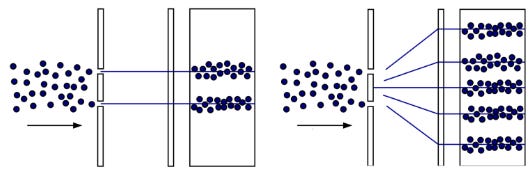
One has to assume the existence of some ill-defined “wave” or “force” or “field” that “guides” the particles along its path, so that they match the interference fringes.1
In fact, let us take a further step in our reasoning and ask ourselves what happens if only one photon is sent towards the double slits. Do interference fringes arise also with a single photon? Or are they the result of the collective interaction of many photons? Or, which seems to be another possible alternative interpretation, does the single particle interfere with itself?
The latter question may seem at first meaningless, because we might object that a single photon could not be subjected to interference, since to observe these interference phenomena we need a collection of photons to build up as fringes on the screen. However, there is a way to test this hypothesis: We could try to deceive Nature by seeing whether and how the interference pattern builds up if we send only one photon after another and then wait to see how things develop over time. One after another means that we shoot a single photon at the two slits, wait until the single photon hits the screen and record its position, and only after that, we send the next photon, wait again until it is detected on the screen, and so on.2
Experimentally this is not easy, but nevertheless possible to accomplish by making the light source extremely dim (for example, take a luminous source and dim it with some almost black foil), in such a manner that it emits only one photon at a time. Then the single photon is forced to go through one or the other slit. If it is a particle, as we imagine it being in our naive intuition, then it cannot go through both slits. If this particle travels through the first slit, then one expects to find it colliding with the detector screen in the region of the first fringe of Fig. 2 left. And when another particle goes through the second slit, then it is expected to hit the second fringe. So, since we are sending only one photon at a time, this seems to be a method to force Nature to manifest its corpuscular aspect.
This experiment proceeds as follows. We produce only very few photons at a time and then look at the detector screen after a short time interval. In Fig. 3a you can observe how only few photons are distributed in an apparently random manner all over the area where previously we observed the interference fringes.
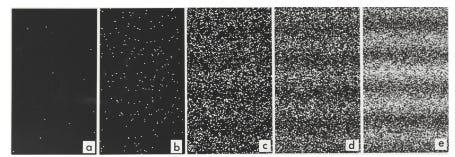
So, there is no hint that interference occurs, and we are happy with that: We believe to have sent through the slits only one photon at a time and we observe only tiny white spots, as expected (even though the random displacement of the photons seems already to disprove the existence of only two lines). If we wait a little longer and collect more events on the detector screen, we see something like in Fig. 3b: Things look still clumpy, but now there definitely seems to be no trace of the two expected white lines. At this stage of the experiment, however, we still cannot discern clearly what the truth is. Then, after collecting a sufficient number of events on the screen, we begin to observe indeed the interference fringes, as in Fig. 3c. And, as we wait even longer and collect larger numbers of spots on the screen, the whole interference structure finally emerges (Fig. 3d and 3e).
Thus, we must conclude that, despite having dimmed our light source to such a degree that it emits only one photon at a time, the wave-particle duality does not disappear. The interference phenomenon is not a collective phenomenon whereby we might imagine many light particles somehow interacting among themselves to produce the interference fringes. Single photons obey the interference law. We might interpret the overall result as if the single particle goes through both slits at the same time, as a sort of “ghostly wave” that is subjected to the laws of diffraction and interference, but then, when its position is measured, suddenly collapses to a single point at the detector screen. There it appears as a little localized spot. The kind of classical model of reality we imagined in Fig. 2 left is no longer tenable at all. It is simply wrong.
What this shows instead is that as long as light is not observed, it travels and expands throughout space as a wave; but when the act of measurement is performed, it chooses to place itself on a specific location. We see that something that seems to behave as a wave, suddenly “collapses” to a point. We will never see the wave and particle nature at the same time.
An important aspect always to keep in mind is that nevertheless, the process is completely random in a sense I will outline in the next post.
Indeed, this is an interpretation that is taken seriously by some physicists, with the so-called pilot wave theory or de Broglie-Bohm theory and that we have address here. But I strongly suggest you carry on reading and learn what so far are the facts, before jumping into the plethora of interpretations of QM; these speculations can boast no hard supporting evidence.
A more precise language would talk in terms of one emission from the photon source followed by one absorption on the detector screen.