
Waves strike back again - Book Excerpt #9
The De Broglie hypothesis

This is section II.5 (that builds upon the previous section here) of the first volume of my book, “Quantum Physics: An Overview of a Weird World.” I plan to post regular updates, including minor and substantial revisions, on Substack. For the full table of contents and guidance on how to follow the book as it unfolds, please click here.
In the last article we saw how thin-film interference arises when light reflecting from different layers travels unequal path lengths, creating phase differences that produce the characteristic color patterns seen in soap bubbles and oil films. The same principle applies at the atomic scale in crystals, where X-ray interference—described by Bragg’s law—reveals diffraction patterns that allow scientists to infer the structure of crystal lattices. That is, we see how light, and even material particles, can be described in terms of wave behavior.
On the other hand, while phenomena such as the double-slit experiment reveal the wave nature of light at macroscopic scales, the photoelectric effect and Compton scattering demonstrate its particle nature at the microscopic level. How can we reconcile such apparent dichotomy?
One might be tempted to believe that, microscopically, light is in fact a particle—in the sense that it might appear and behave like a wave only at human scales, while close observation at the scale of molecules, atoms, and particles reveals it to be a particle and just like a water wave to be microscopically made up of tiny H20 water molecules.
Not so. Bragg diffraction and interference phenomena act at the size of an atomic crystal lattice layer and cannot be explained with classical particle behavior. Considering light merely as a wave, Bragg father and son could explain the observed phenomenon, just as Young did using the double-slit experiment. In fact, Young would have been delighted to see the wave nature of light confirmed also at microscopic scales.
But there is much more. One question that must arise at this point is whether this ambiguous twofold wave-particle manifestation is something inherent only to light. Since light seems to present itself as a wave or a flux of particles according to whichever kind of experimental setup one chooses, does this duality also hold true for material particles with a mass, like electrons or protons?
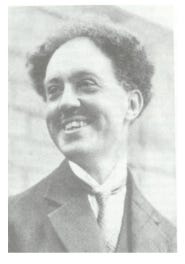
It might sound unreasonable and counterintuitive to think of material particles like an electron, which we imagine as a tiny chunk of matter, to behave like a wave as photons do. But an attempt to categorize them under the same umbrella came from the French physicist Louise de Broglie, who was able to synthesize in a unique theoretical concept the corpuscular and wavy nature of material particles.
What de Broglie realized was that there is no logical and physical reason to believe that material particles with a mass could not have this double corpuscular and wavy nature as well as photons do. He imagined all the particles—including those which make up objects like atoms, molecules, and every material body in the Universe—no longer as particles or waves but as something which contains both, conceptually speaking: the so-called wave
packet.
This was the famous de Broglie hypothesis, framed in 1924. The idea was to imagine every object being a traveling wave, but with the special property of being localized in space. If we see things in this perspective, we can consider any particle (with or without a mass) as having a specific wavelength, with the amplitude of the wave having a maximum in a region of space and which we intuitively think of as being classically the position of the particle, but with this amplitude decaying quickly from the center of the peak in all directions.
In Fig. 2 two arbitrary examples of wave packets are shown: on the left a broader wave packet and on the right a smaller one. The two differ in their wavelengths.
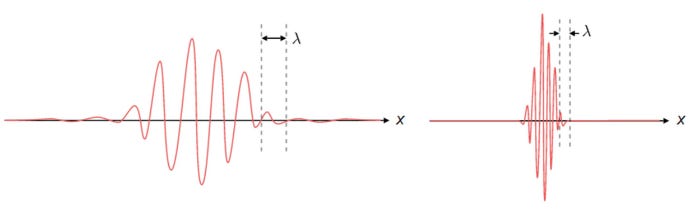
If you look at these wave packets in Fig. 1 from a large distance compared to their wavelengths (say, from a distance of ten meters from you monitor), you may approximately consider them particles, since their wavy nature is no longer discernible to your eye. But if you look at the wave packets at a distance of the order of their wavelengths or shorter, they appear to be waves. In this sense we may speak of particle wavelength: an expression which otherwise, in the classical context, would have seemed an oxymoron.
A gentle warning is compulsory here. One might be tempted to interpret the size of the wave packet as the size of the particle or the object under consideration. However, we shall see that this intuitive understanding is not correct. For the time being, just take the wave packet for what it is: a mathematical abstract construct that helpfully explains the observed phenomena of the experiments where the particle- and wave-nature can coexist.
L. de Broglie quantified all this with a very simple and neat formula, which relates the wavelength λ of a particle, or more precisely the wavelength of its corresponding wave packet, as being inversely proportional to its momentum p, which in classical mechanics is defined as the product of its mass m times its velocity v: p = m v. De Broglie’s wavelength is then defined as:
where h is, as usual, Planck’s constant. The right-hand side of the equation holds true only for material particles with a nonzero mass and is correct only if we ignore relativistic effects. On the other hand, the term h*p is more general and has universal validity, for photons as well as for material particles, and is exact also in relativity. It associates a wavelength with any kind of particle, independently if it has a mass (say an electron, proton, or a neutron), which moves with speeds less than that of light, or if it is massless, as in the case of photons, and which, in vacuum, always has no other possible speed than c.
This can be shown with a (not too rigorous) proof which highlights where this equation comes from. From Einstein’s mass-energy relation E=mc^2 we know that the mass m can be rewritten as m = E/c^2 . If we take seriously the idea to put photons and material particles on the same footing, we can replace the mass in Eq. 1 with the latter expression and the speed with that of light (v = c) to obtain:
This expresses the momentum a photon of energy E carries. Photons, as all other particles, are able to carry and transmit certain amounts of momentum to other particles. Recall how photons, even when not visualized as material particles themselves, are able to give a “kick,” so to speak, to material particles, as we already saw in the case of Compton scattering.
Now, recall also the ever-present Planck’s relation: E = hν = h c/λ . Rewriting all of this in terms of λ, we obtain:
with the last replacement due to Eq. 2. This proves de Broglie’s relation.
So, what de Broglie did was to put together the concept of the wave and particle into a single entity: the wave packet, the wavelength of which is determined by its momentum. In the case of material particles—not photons but particles with a mass moving slower than the speed of light—it is customary to speak also of so-called matter waves.
In the next article we will see how the matter wave of the de Broglie hypothesis also sheds further light on Bohr’s atomic model.